Unemployed Members – Dues

Any individual Full or Senior, or a Fellow member may participate in ASQ’s unemployment dues relief program if they want to continue maintaining their ASQ membership. For more information:

  • Log-in to your ASQ account, go to the My Account page, select Unemployed Members on the left panel. The Unemployed Member Dues page appears.
  • Download the ASQ Unemployment Program Application, complete and submit to ASQ-HQ.
  • Don’t forget to Log-out.

Tout membre individuel Titulaire, Senior ou Fellow peut participer au programme d’allègement des cotisations de chômage de l’ASQ s’il souhaite continuer à maintenir son adhésion à l’ASQ. Pour plus d’informations:

  • Connectez-vous à votre compte ASQ, allez sur la page Mon compte (My Account), sélectionnez Membres chômeurs (Unemployed Members) sur le panneau de gauche. La page Cotisations des membres chômeurs (Unemployed Member Dues) s’affiche.
  • Téléchargez la Demande d’adhésion au programme de chômage de l’ASQ (ASQ Unemployment Program Application), remplissez et envoyez à ASQ-HQ.
  • N’oubliez pas de vous déconnecter.

Unemployed Members – Dues Read More »

Voice of The Customer | Voix du Client

Cesar Camargo 2023

Cesar Camargo 2023By Cesar Camargo, Responsable VoC, (English text follows)

Ce premier quadrimestre de l’année a été riche en événements fascinants au sein de notre chapitre ASQ Montréal. Grâce à vos commentaires, contributions et propositions de sujets à aborder, nous avons pu, en ce début d’année 2025, profiter de discussions enrichissantes sur l’intelligence artificielle, la gestion du changement, le monde BANI et la quête d’alignement au sein de nos organisations.

Lors de notre tout dernier webinaire, Nilufer Erdebil nous a guidés sur une voie passionnante pour atteindre plus de clarté et parvenir à ce tant désiré alignement entre les personnes, les processus et les objectifs de l’entreprise.

Cet événement a reçu un taux de satisfaction générale de 94%. La thématique et la conférencière ont été perçues positivement à 95%, tandis que l’approche a obtenu un taux de satisfaction de 94% et l’interaction de 92%.

Nous remercions tous les participants ayant partagé leurs avis et commentaires. La voix de nos membres est le carburant qui nous permet de continuer à œuvrer pour apporter de la valeur à vos vies professionnelles et personnelles.

“De même qu’il y a un art de bien parler, il existe un art de bien écouter.” **

** Épictète de Phrygie (55-135 AD), philosophe gréco-romain.

Cesar Camargo


This first quarter of the year has been filled with fascinating events at our ASQ Montreal chapter. Thanks to your feedback, contributions, and suggestions for topics, we have been able to enjoy enriching conversations throughout 2025 on Artificial Intelligence, Change Management, the BANI World, and the ongoing search for alignment within our organizations.

In our most recent webinar, Nilufer Erdebil guided us on an inspiring journey toward achieving clarity and reaching the much-desired alignment between people, processes, and organizational purpose.

This event received a 94% overall satisfaction rating. The topic and the speaker were positively rated at 95%, while the approach received a 94% satisfaction score and interaction was rated at 92%.

We extend our sincere thanks to all participants who shared their evaluations and comments. The voices of our members are the driving force that allows us to continue working to bring value to your professional and personal lives.

“Just as there is an art of speaking well, there is an art of listening well.” **

** Epictetus of Phrygia (55–135 AD), Greco-Roman philosopher.

Cesar Camargo


Voice of The Customer | Voix du Client Read More »

Si vous étiez présent | Had You Been There

RÉSUMÉ DU WEBINAIRE “COMBLER LES ÉCARTS: ALIGNER LES PERSONNES, LES PROCESSUS ET LA FINALITÉ”
(SUMMARY OF WEBINAR “BRIDGING THE GAPS: ALIGNING PEOPLE, PROCESSES AND PURPOSE”)

Par Claudio Sasseron, expert en Qualité et Amélioration Continue (An English text follows)

Organisé par Samira KAZEMI et Ray DYER, sur la plateforme Zoom.

Présentateur: Mme Nilufer Erdebil, expert en Design Thinking, conférencière TEDx et TEC/Vistage, auteure de Future Proofing by Design, et PDG de Spring2 Innovation

​Le mercredi soir 23 avril 2025, vingt-quatre participants ont assisté à un webinaire de 2,5 heures organisé par ASQ Montréal. La séance a débuté par une période de réseautage animée par M. Ray Dyer, offrant aux participants l’occasion de rencontrer des membres de l’équipe de direction d’ASQ Montréal, notamment Pierre Marquis, ainsi que la conférencière Nilufer Erdebil.

Nilufer Erdebil, ingénieure avec plus de 25 ans d’expérience dans les secteurs public et privé, a débuté sa carrière dans le développement de produits militaires. En tant que fondatrice et PDG de Spring2 Innovation, elle a dirigé des initiatives de transformation, aidant les équipes à relever des défis complexes et à stimuler la croissance stratégique.​

L’approche Deeper Clarity combine l’alignement, le design thinking, la prévision stratégique et un état d’esprit de croissance. Nilufer a rappelé que, face à l’accélération des technologies comme l’IA, la clarté humaine et un objectif commun sont essentiels pour garder les équipes concentrées et résilientes. Pour illustrer l’importance de l’alignement, elle a comparé les équipes aux roues d’une voiture: mal alignées, elles ralentissent la progression.

Elle a aussi insisté sur l’importance de la confiance et de la collaboration dans les équipes diversifiées, où chaque membre se sent reconnu et motivé, favorisant ainsi l’innovation.

En s’appuyant sur son expérience en patinage artistique, Nilufer a montré comment discipline et adaptabilité sont cruciales pour performer. Elle a également cité le Modèle de décision de l’Ontario utilisé par la police, qui montre l’importance d’une réévaluation continue pour rester aligné sous pression. Adopter un état d’esprit de croissance aide ainsi les équipes à surmonter les défis et à saisir les opportunités.

Des étapes pratiques pour la cohésion d’équipe ont été présentées, avec des exemples tels que la manière dont le désalignement dans les opérations d’un terminal aéroportuaire peut affecter directement la satisfaction des clients, mettant en évidence les conséquences tangibles des déconnexions organisationnelles.​

Les participants ont quitté la session munis d’outils pour identifier les premiers signes de désalignement au sein des équipes, appliquer le cadre DROP pour favoriser des équipes cohésives et efficaces, et mettre en œuvre des exercices pratiques pour renforcer l’alignement dans des contextes réels.

Merci à ASQ Montréal et à Nilufer Erdebil pour cette excellente initiative.


Organized by Samira KAZEMI and Ray DYER, on the Zoom platform.

Presenter: Ms. Nilufer Erdebil, design thinking expert, TEDx and TEC/Vistage speaker, and author of Future Proofing by Design. CEO of Spring2 Innovation.

On Wednesday evening, April 23, 2025, twenty-four participants attended a 2.5-hour webinar organized by ASQ Montreal. The event began with a networking session led by Mr. Ray Dyer, providing attendees the opportunity to connect with members of the ASQ Montreal leadership team, including Pierre Marquis and the presenter, Ms. Nilufer Erdebil.

Nilufer Erdebil, an engineer with over 25 years of experience in both government and business sector, started her career working on military product development. As the founder and CEO of Spring2 Innovation, Nilufer has led transformative initiatives, helping teams tackle complex challenges and drive strategic growth.

​ The Deeper Clarity approach combines alignment, design thinking, strategic foresight, and a growth mindset. Nilufer emphasized that, in the face of accelerating technologies like AI, human clarity and a shared purpose are essential to keep teams focused and resilient. Highlighting the importance of alignment, she used the analogy of a car’s wheels: if they are not properly aligned, the vehicle cannot move efficiently.

She also discussed building trust and collaboration, noting that strong relationships within diverse teams create an environment where members feel valued, which ultimately leads to better collaboration and greater innovation.

Drawing from her figure skating experience, Nilufer explained how discipline and adaptability are crucial in high-performing teams. She also referred to the Ontario Decision Model used in police encounters, showing how continuous reassessment helps teams stay flexible and aligned under pressure. Adopting a growth mindset enables teams to navigate challenges and seize opportunities more effectively.

Practical steps for team cohesion were presented, with examples like how misalignment in airport terminal operations can directly affect customer satisfaction, highlighting the tangible consequences of organizational disconnects.​

Participants left the session equipped with tools to identify early signs of misalignment within teams, apply the DROP framework to foster cohesive and effective teams, and implement practical exercises to reinforce alignment in real-world contexts.

Thank you to ASQ Montreal and Nilufer Erdebil for this excellent initiative.

Si vous étiez présent | Had You Been There Read More »

Student Outreach | Sensibilisation étudiante

Pierre Marquis, Membership Chair Section Montréal, Student Outreach Committee Member (An English text follows)

Notre comité de sensibilisation des étudiants sera de retour en juin 2025. Restez à l’écoute.

ACADEMIA:

  • Contactez-nous si vous souhaitez organiser un événement avec vos étudiants et discutons de la manière dont nous pouvons aborder le sujet de la qualité dans le monde universitaire.
  • Si vous faites partie d’un établissement d’enseignement et que vous souhaitez avoir plus de visibilité sur les sujets liés à la qualité, contactez Pierre Marquis sur LinkedIn. Nous disposons d’un réseau de conférenciers potentiels qui pourraient vous intéresser.

Our Student Outreach Committee will be back in June 2025. Stay tuned.

ACADEMIA:

  • Contact us if you are organizing a student event and wish to discuss how to present quality-related topics in the university.
  • If you are part of an educational institution and would like to have more visibility on quality-related topics, please contact Pierre Marquis on LinkedIn. We have a network of potential speakers that may be of interest to you.


Student Outreach | Sensibilisation étudiante Read More »

ASQ Certification Study Group

Dr David TozerBy Dr. David Tozer, Ph.D., ASQ CQE and SSBB, Education & Audit Chair.

Would you like to work with others to prepare for ASQ examinations? We have a Teams based section study group that is open every Tuesday evening from 7:00 pm to 8:30 pm.

Join the team and get to help each other. Contact the host Dr. David Tozer, Montreal Section Education Chair, to obtain a link.


Aimeriez-vous travailler avec d’autres personnes pour préparer les examens de l’ASQ ? Nous avons un groupe d’étude Teams ouvert tous les mardis soirs de 19 h à 20 h 30.

Rejoignez l’équipe et aidez-vous mutuellement. Contactez l’hôte, Dr. David Tozer, président de l’éducation de la section de Montréal, pour obtenir un lien.

ASQ Certification Study Group Read More »

The Editor’s Corner | Mot de l’éditeur

Michael Bournazian

By Michael Bournazian, Eng., Newsletter Editor, ASQ Senior Member, Quality Management Professional, CSSGB with Rolls-Royce

I want to take my “Corner” opportunity this month to highlight 2 ASQ Montreal in-person events that are coming up in 2025:

1) First off, on June 18th we will hold our latest networking event, a chance for Quality professionals to meet face-to-face and discuss our favourite topic (yes, that one!). Venue still to be determined, so stay tuned.

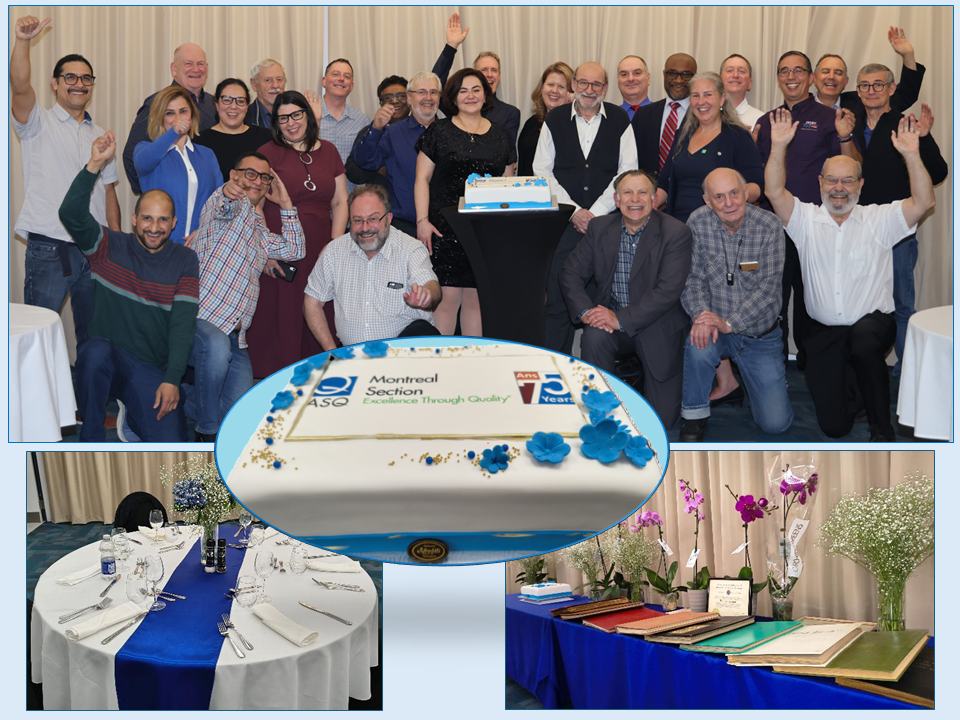
2) Secondly, our October 22nd event will be ASQ Montreal’s 75th birthday celebration. A milestone achievement thanks to the hard work of more people than I can name. Hopefully you have been reading the monthly newsletter articles being written by J.P. Amiel and Sam Weissfelner regarding the storied history of our section. Again, venue still to be determined, but save the date!

**********************************************

Any feedback? Click on the link and let me know.

ALSO . . .  Please contact me or any one else on the Leadership team if you would like to:
1) Write and submit an article to be published in the Newsletter.
2) Write a review of one of the upcoming monthly webinars for the “Had You Been There” section.

Thank you, all the best and none of the worst.


The Editor’s Corner | Mot de l’éditeur Read More »

ASQ Montreal Section – Education Program 2025

Dr David TozerBy Dr. David Tozer, Ph.D., ASQ CQE and SSBB, Education & Audit Chair.

Having ASQ certification gives you an edge in the market and can significantly increase your income.

ASQ Certification often leads to higher paying employment.  The money invested in education and certification increases chances of finding employment quickly in the downsizing environment we live in.

For advice on the program, contact David Tozer at davidtozer@qualitiqua.com or call 514-694-2830.

The following is a list of the certifications and some of the topics covered.

Certified Quality Engineer: Topics include: quality concepts, cost of quality, human resources, team formation and group dynamics, inspection, metrology, sampling, reliability, quality standards, quality audit, statistics, design of experiments, process improvement, liability, and modern management methods for improving quality.

Certified Reliability Engineer: Topics include: reliability management, probability and statistics, modelling and prediction, data collection and analysis, design for reliability, maintainability and availability, reliability testing, product safety and liability.

Certified Software Quality Engineer: Topics include: cost of quality and return on investment, team formation and group dynamics, Life Cycles and Process Models, Systems Architecture, Requirements Engineering, Requirements Management, Audits, Maintenance Management, Software Analysis, Tracking and Controlling, Risk Management, Process and Product Measurement, Analysis and Reporting Techniques, Software Verification and Validation, Software Configuration Management.

 Certified Quality Inspector: Topics include: quality concepts, team formation and group dynamics, geometry, metrology, reading drawings, mechanical processes, statistical process control, inspection, and sampling.

Certified Quality Technician: Topics include: quality concepts, team formation and group dynamics, planning for sampling, problem solving, procedure and instruction preparation, statistical methods, cost of quality.

Certified Calibration Technician: Topics include: testing, calibration, repair, maintenance, environment, electrical, mechanical and electro-mechanical equipment.

Certified Quality Improvement Associate: Topics include: quality tools, improvement projects and teams.

Certified Quality Process Analyst: Topics include: problem solving methods, quality tools, improvement projects and teams,

Certified Master Black Belt: Requirements: Many years experience at the Six Sigma Black Belt level, portfolio of achievements, demonstration of practice and advancing the quality field.

Certified Six Sigma Black Belt: Topics include: quality concepts, cost of quality, enterprise-wide deployment, business process management, project management, team formation and group dynamics, define, measure, analyze, improve, control, lean enterprise, statistics, design of experiments, and design for six sigma.

Certified Six Sigma Green Belt: Topics include: quality concepts, cost of quality, enterprise-wide deployment, business process management, project management, team formation and group dynamics, define, measure, analyze, improve, control, and statistics.

Certified Six Sigma Yellow Belt: Topics include: problem solving using Define, Measure, Analyse, Improve, Control.

Certified Manager of Quality/Organizational Excellence: Topics include: quality concepts, quality planning, customer focus, quality standards, project management, cost of quality, team formation and group dynamics, human resources and improvement. 

Certified Quality Auditor: Topics include: quality concepts, team formation and group dynamics, management responsibility, audit objectives, audit preparation, audit conduct, audit reporting, sampling, and basic statistics.

Certified Food Safety and Quality Auditor: Topics include: auditing for Food Safety, HACCP, managing methods for food safety, reporting on food safety.

Certified Medical Device Auditor: Topics include: standards, regulations, directives, guidance, systems and controls, auditing.

Certified Pharmaceutical GMP Professional: Topics include: human and veterinarian, standards and regulations, raw material management, manufacturing control, pharmaceutical delivery methods, packaging and labeling, auditing,

Certified Construction Quality Manager: Topics include: contract management, quality planning, resource management, documentation, closing the contract, risk management, environment, safety, team building, quality tools and statistical methods.

Certified Supplier Quality Professional: Topics include: supply chain quality, quality assurance plans, scrap reduction, repair and rework cycle time.

ASQ Montreal Section – Education Program 2025 Read More »

ASQ Montreal – 75 Years of History – Events | Événements

75 Years of History — Events | Événements


Sam Weissfellner & Jean-Pierre Amiel

Sam Weissfelner, ASQ Senior, ASQ CSQE, CQA, Nominations Committee Chair and Historian, with
Jean-Pierre Amiel, ASQ Senior, ASQ CQA, Past Historian

Souvenirs . . .

Au cœur de notre mission “Promouvoir et améliorer la profession de la qualité . . .“, nous nous sommes engagés à offrir “. . . de l’information, des programmes éducatifs et des événements, et à promouvoir la sensibilisation et la valeur de la qualité dans la communauté“. Par conséquent, la deuxième raison pour laquelle vous pourriez adhérer à la section de Montréal est de maintenir et de partager vos connaissances dans le domaine de la qualité ainsi que de nouer des contacts lors des divers événements que nous organisons régulièrement.

En janvier dernier, nous vous expliquions qu’en plus de 75 ans d’existence, la Section de Montréal a organisé ou participé à plus de 471 événements (présentations, forums, visites d’usine, ateliers, etc.) sur une multitude de sujets. Parmi ces événements, nous avons organisé 27 forums (certains diffusés par satellite, oui, c’était avant le “streaming”, Zoom et Teams) et offert plus de 27 activités de réseautage. De nombreux secteurs industriels locaux ont été présentés: Aérospatiale 44; Électronique 26; Alimentation 8; Métal 8; Santé 6; Automobile 5; Médical 4 et Pharmaceutique 4. 

Lorsque possible, nous avons même organisé des visites d’usines, une activité favorite qui permet à nos invités de visiter, de voir et de sentir une variété d’environnements industriels. Vous comprendrez également qu’au fil des ans, nous avons rencontré, introduit et encouragé de nombreuses sessions de dialogue et d’information, ainsi que des opportunités pour nos membres de nouer des contacts, de socialiser, d’échanger des idées et d’être à l’affût d’opportunités d’emploi et de formation. Certains de nos événements préférés sont sans aucun doute les ateliers pratiques sur les outils de base et des exemples de vie, dont voici quelques exemples (regardez certains de ces noms d’entreprises):

At the heart of our mission “To promote and enhance the quality profession . . .“, we have committed to offering “. . . information, educational programs and events, and promoting the awareness and value of quality in the community.” Consequently, the number two reason that you might have to join the Montreal Section is to maintain and share your knowledge in the quality profession, as well as to make contacts during the various events that we hold regularly. 

Back in January, we explained how in our over 75 years of existence, the Montreal Section has hosted or participated in over 471 events (presentations, forums, plant tours, workshops, etc.) on a multitude of subjects. Of these events, we organized 27 Forums (some over satellite broadcasts, yes, that was before “streaming”, Zoom and Teams) and offered more than 27 networking-specific activities. Many of our local industry sectors were presented: Aerospace 44; Electronics 26; Food 8; Metal 8; Healthcare 6; Automobile 5; Medical 4 and Pharmaceutical 4.

When possible, we even organized plant tours, a favourite activity allowing our guests to visit, see and feel a variety of industrial environments. You might also understand that over the years, we have met, introduced and encouraged a lot of dialogue and information sessions as well as opportunities for our members to network, socialize, exchange ideas and be on the look-out for job and education opportunities. Some of our favourite events are definitely how-to workshops on basic tools and life examples, here are some examples (look at some of those company names): 

1957 — Quality Control Pays-Off in Woodwork — Robert Chateauneuf, Singer Manufacturing Co.
1963 — QA Engineering in Tech Products, Electron Tube QC, Plant Tour RCA Victor Co — H. R. Streete & R. J. Wallace
1964 — Control of Quality and Quality Control — Hasgaard, Manager QC, Canadian Marconi Co.
1976 — Quality Cost Seminar
1977 — Metrication and Quality | Quality Costs — M. Marette, Northern Telecom
1982 — Quality Costs — George Lazlo, Director QA, Canadair Ltd.
1993 — Empowering Employees, Workshop with Section Québécoise — Joseph A. Maalouf & Pascal Bouffard
1996 — You’ve Got to be Crazy to be in Quality — Michel David, VP Quality, Pratt & Whitney | The Basic Tools of Quality – Workshop — David Tozer
1999 — Modern Quality Tools — David Tozer
2002 — Quality Tools; Raymond Dyer, Nortel Networks, Michel Hodak, WECO Electrical Connectors Inc. & David Tozer, D. Tozer & Associates.
2003 — Advanced Quality and Statistical Tools; Martin Carignan, Bezeau, Carignan et associés & David Tozer, D. Tozer & Associates.
2005 — Basic Quality Tools – Workshop — David Tozer | Learning to see – An introduction to Lean Enterprise Concepts and Tools — Stephen Jones
2009 — Using Financial Tools to Improve Quality — Livio Di Francesco
2010 — ASQ Montreal Section 60 Years Anniversary — Workshop: Brenda Fisk — Presentation: Jean-Pierre Amiel | Brainstorming Tool On Retention: ASQ World Café Meeting — Brenda Fisk
2013 — Applying Six Sigma Tools in a Hospital Setting — Carmin Cristofaro
2015 — Lean Maturity Assessment Tool — Marie-Hélène Jobin | A Quality Night of Pecha Kucha Presentations — Eric Hosking, Dr. David Tozer, Anne-Marie Pizzitelli and Jim Moran
2019 — Supply Chain Management & challenges in Aerospace, Pharmaceutical & Automotive Sectors — Animation: Sam Weissfelner — Panelists: Pierre Bedard, Robert Fairbairn and George Azedo
2023 — In-person Networking, good food and friends — Animation: Raymond Dyer
2024 — 3 Manufacturing tools: GD&T, Model Based Definition and Twyn — François Nadeau

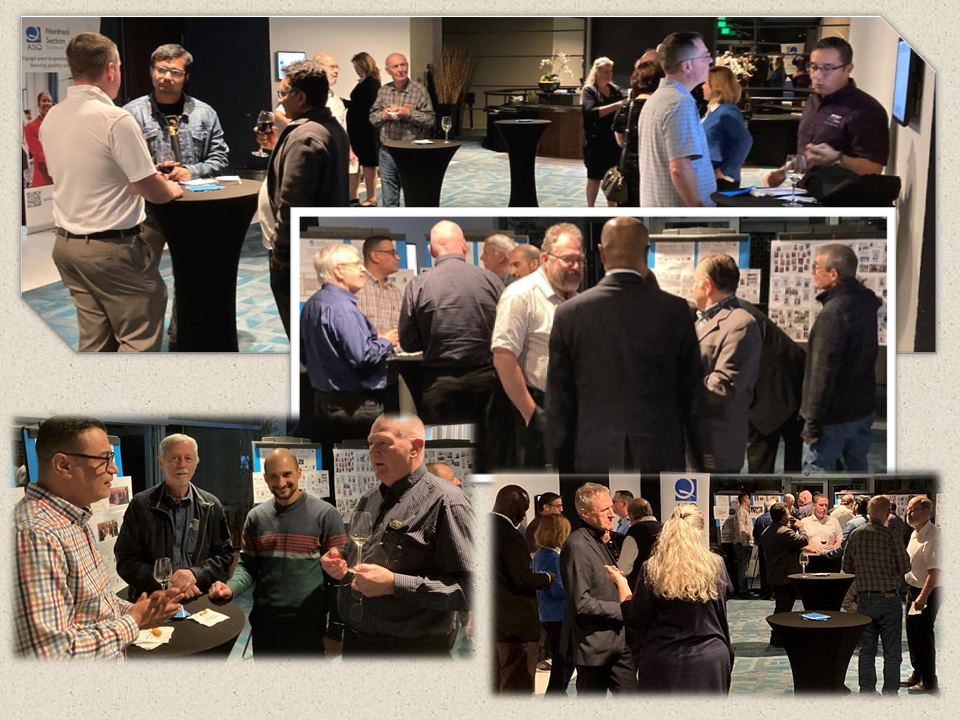
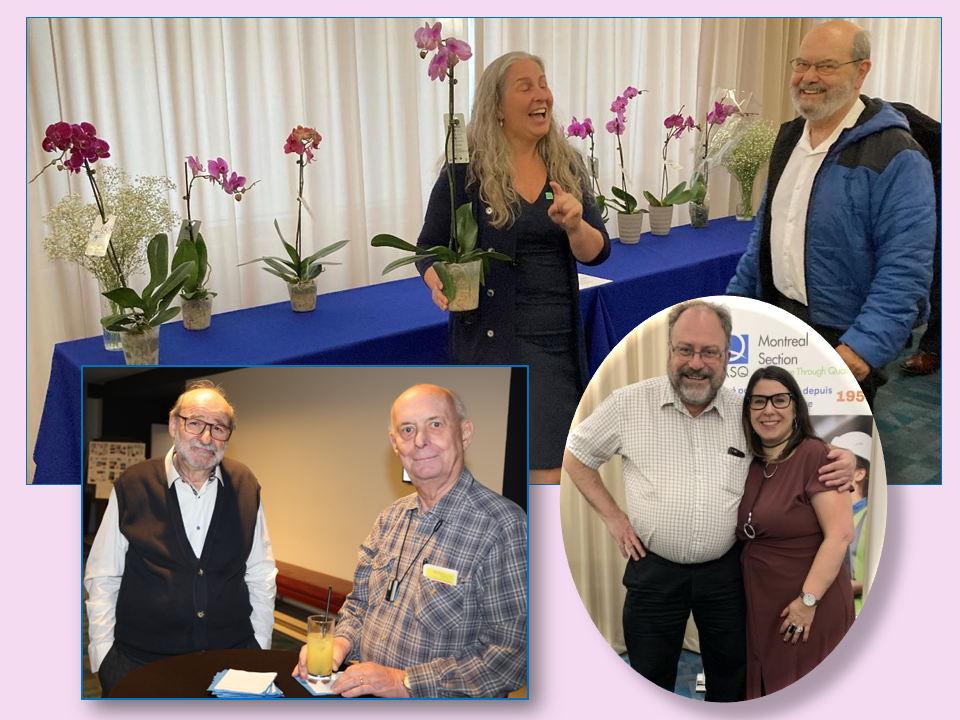
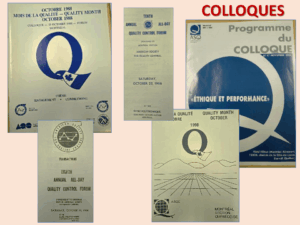
Voici quelques un de ces événements capturés par la caméra. Here are some of those moments casually captured by the camera.


Vous vous demandez quelle est la première raison pour nous rejoindre? Ce sont les 18 programmes de certification de l’ASQ. Lisez ce résumé de Jean-Pierre sur les certification de l’ASQ. Elles vous offrent la possibilité de dire à tout le monde que votre expérience et vos connaissances ont été évaluées par une organisation de qualité de premier plan (ASQ) par rapport à un ensemble de connaissances d’une catégorie du domaine de qualité spécifique (les examens de certification de l’ASQ sont uniquement dispensés en anglais).

Wondering what the number one reason to join us would be? Well, it is ASQ’s 18 Certifications programs. Read JP’s summary on ASQ’s Certification. They offer you an opportunity to tell everyone that your experience and knowledge has been evaluated by a leading quality organization (ASQ) against a specific quality domain body of knowledge category (ASQ certification examinations are only delivered in English). 

See you soon, à bientôt.

Quelque chose de nouveau à ASQ . . .
Something new at ASQ . . . 


ASQ Montreal – 75 Years of History – Events | Événements Read More »

ASQ Certification Study Group

Dr David TozerBy Dr. David Tozer, Ph.D., ASQ CQE and SSBB, Education & Audit Chair.

Would you like to work with others to prepare for ASQ examinations? We have a Teams based section study group that is open every Tuesday evening from 7:00 pm to 8:30 pm.

Join the team and get to help each other. Contact the host Dr. David Tozer, Montreal Section Education Chair, to obtain a link.


Aimeriez-vous travailler avec d’autres personnes pour préparer les examens de l’ASQ ? Nous avons un groupe d’étude Teams ouvert tous les mardis soirs de 19 h à 20 h 30.

Rejoignez l’équipe et aidez-vous mutuellement. Contactez l’hôte, Dr. David Tozer, président de l’éducation de la section de Montréal, pour obtenir un lien.

ASQ Certification Study Group Read More »

ASQ Montreal – 75 Years of History – The Boxes/Les Boites

75 Years of History — The Boxes | Les boites


Sam Weissfellner & Jean-Pierre Amiel

By Sam Weissfelner, ASQ Senior, ASQ CSQE, CQA, Nominations Committee Chair and Historian, with
Jean-Pierre Amiel, ASQ Senior, ASQ CQA, Past Historian

Out of the Box . . . Sortie de la boîte

Welcome to our first article of our new column entitled “Out of the Box“.
Bienvenue dans ce premier article de notre nouvelle rubrique intitulée “Sortie de la boîte“.

Why that title you say?
Well, it’s been a number of years that we have kept all types of documents dealing with our section’s evolution and activities. With the upcoming 75th Anniversary approaching rapidly, your section historical team decided to revisit some of the archives for inspiration. Sam and JP agreed to randomly select one box at a time, and write an article based on the contents in said box. Hence, the title “Out of the Box“. 

Our first foray into this yielded a gold mine of original documentation from the founders of the Montreal Section beginning in 1950 and onwards. This article is based on that first “OUT OF THE BOX” set of files that we encountered. Here are a few “nuggets” on what these documents reminded us.

In the 1940s, local Quality Control Societies had been established in Canada. In Montreal, the leaders of the group were Ben H. Lloyd of Canadian Industries Ltd (CIL), Bruce Leadbetter and John Pringle of the Bell Telephone Co. of Canada (now Bell), Roger Lessard of the École Polytechnique of the Université de Montréal, N.L. Morgan of Northern Electric (it became Nortel in the 1990s and went bankrupt in 2009), and others.

In 1949, they decided to join the American Society for Quality Control (ASQC). See the first two letters from our section files, below, from N.L. Morgan of Northern Electric to B.H. Lloyd of CIL, describing their intention to meet further following an interest by the ASQC to add Canadian members to the society. Within a few months, the Montreal Section would become Section 0401 of the Northern Region, later designated as Region 4 (Canada).

Vous vous dîtes pourquoi ce titre?
Eh bien, cela fait un certain nombre d’années que nous conservons toutes sortes de documents relatifs à l’évolution et aux activités de notre section. Le 75e anniversaire approchant à grands pas, l’équipe d’historien de votre section a décidé de revisiter certaines de ces archives pour y puiser de l’inspiration. Sam et JP se sont mis d’accord pour choisir au hasard une boîte à la fois et écrire un article basé sur le contenu de cette boîte. D’où le titre “Sortie de la boîte“.

Notre première incursion dans ce domaine nous a permis de découvrir une mine d’or de documents originaux provenant des fondateurs de la section de Montréal à partir de 1950. Cet article est basé sur ce premier ensemble de dossiers “SORTIE DE LA BOÎTE” que nous avons rencontré. Voici quelques “pépites” sur ce que ces documents nous ont reméroré.

Dans les années 1940, des sociétés locales de contrôle de la qualité ont été créées au Canada. À Montréal, les leaders du groupe sont Ben H. Lloyd de Canadian Industries Ltd (CIL), Bruce Leadbetter et John Pringle de Bell Telephone Co. of Canada (aujourd’hui Bell), Roger Lessard de l’École polytechnique de l’Université de Montréal, N.L. Morgan de Northern Electric (devenue Nortel dans les années 1990 et mise en faillite en 2009), et d’autres encore.

En 1949, ils décident d’adhérer à l’American Society for Quality Control (ASQC). Voir les deux premières lettres tirées des dossiers de notre section, ci-dessous, de N.L. Morgan de Northern Electric à B.H. Lloyd de CIL, décrivant leur intention de se rencontrer à nouveau suite à l’intérêt de l’ASQC d’ajouter des membres canadiens à la société. En quelques mois, la section de Montréal devient la section 0401 de la région du Nord, qui deviendra plus tard la région 4 (Canada).

The Montreal Section held its first meeting on September 21st, 1950 with 25 members attending. As of April 30, 1951, total membership of the ASQC was 4,153 quality practitioners – 423 in the Northern Region (Canada). There were 30 in Montreal and 64 in Toronto.

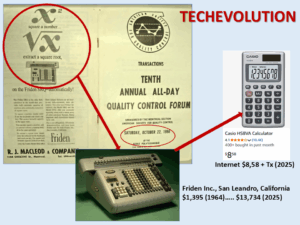
We also found this example of the 1955-56 ASQC Membership Card of Maxwell Heayberd of Dominion Rubber Co. (became Uniroyal in 1966). And, note that in the Statement below, sent to F.W. Davidson on July 1, 1955, the membership dues were $10, including a $3 fee for subscription to the Industrial Quality newsletter. Although it is not specified if this was in US or Canadian currencies, in 2025 dollars, this would be about either $131.81 CA or $129.60 US. An extra $1 was collected for each Division membership (Chemical or Textile). Oh, by the way, the postage for mailing that statement was 1,5 cents! 🔅

La section de Montréal a tenue sa première réunion le 21 septembre 1950 en présence de 25 membres. Au 30 avril 1951, l’ASQC comptait 4 153 praticiens de la qualité, dont 423 dans la région du Nord (Canada). Il y en avait 30 à Montréal et 64 à Toronto.

ASQC Membership Card Max Heyberd 1955-56

Nous avons également trouvé cet exemple de carte de membre de l’ASQC 1955-56 de Maxwell Heayberd de Dominion Rubber Co. (devenu Uniroyal en 1966).

Notez que dans l’État de compte ci-dessous, envoyée à F.W. Davidson le 1er juillet 1955, la cotisation était de 10$, dont 3$ pour l’abonnement au bulletin Industrial Quality. Bien qu’il ne soit pas précisé s’il s’agit de la monnaie américaine ou canadienne, en dollars de 2025, cela représenterait environ 131,81$ CA ou 129,60$ US. Un dollar supplémentaire a été perçu pour chaque adhésion à une division (chimique ou textile). Au fait, les frais d’affranchissement pour l’envoi de ce relevé s’élevaient à 1,5 cents!

🔅 🔅

ASQC Membership Statement F Davidson 19551128 To put all of these amounts in context, according to www.in2013dollars.com, one 1950 Canadian dollar ($1 CA) has the equivalent purchasing power in 2025 of about $12.96, a US dollar would be worth $13.18.

According to the Statistics Canada consumer price index, today’s prices are almost 13 times as high as average prices since 1950, and basically, a 2025 dollar would only buy 7.72% of what it could buy back then when the inflation rate was 2.67%. How slightly depressing for us today. 🔅

Pour mettre ces chiffres dans leur contexte, selon www.in2013dollars.com, un dollar canadien de 1950 (1$ CA) a un pouvoir d’achat équivalent en 2025 d’environ 12,96$, et un dollar américain vaudrait 13,18$.

Selon l’indice des prix à la consommation de Statistique Canada, les prix d’aujourd’hui sont presque 13 fois plus élevés que les prix moyens depuis 1950, et en gros, un dollar de 2025 n’achèterait que 7,72% de ce qu’il pouvait acheter à l’époque, lorsque le taux d’inflation était de 2,67%. C’est légèrement déprimant pour nous aujourd’hui.

🔅 🔅

On the bright side, World War II had ended five years prior and, although many were still struggling to get back on their feet, it was the beginning of the baby boomer generation
Un positif
, la Seconde Guerre mondiale avait pris fin cinq ans plus tôt et même si de nombreuses personnes avaient encore du mal à se remettre sur pied, c’était le début de la “génération du baby-boom”.

See you soon.


ASQ Montreal – 75 Years of History – The Boxes/Les Boites Read More »

Student Outreach | Sensibilisation étudiante

Pierre Marquis, Membership Chair Section Montréal, Student Outreach Committee Member (An English text follows)

RÉSUMÉ du Panel SIX SIGMA organisé par Mme Anjali AWASTHI de l’UNIVERSITÉ CONCORDIA

Prestation assurée par trois membres du panel: Pierre GAUDET, B.ing/M.ing/CSSBB, Eric HOSKING, B.ing/MBA/SSBB et Pierre MARQUIS, B.ing./MBA/SSBB.

Le vendredi 21 mars 2025, le panel a été accueilli par Mme Anjali AWASTHI, Ph.D et professeure, pour participer à une discussion sur le Lean Six Sigma (LSS). Un total de sept étudiants en génie se sont présentés, intéressés par cette méthodologie de résolution de problèmes.

Les objectifs de la présentation étaient:

  • Partager les expériences de projets LSS avec les étudiants;
  • Discuter de la démarche DMAIC et des défis dans l’approche LSS;
  • Élaborer sur l’intersection de l’ingénierie et de la qualité;
  • Reconnaître le rôle de l’ASQ et les bénéfices comme membre étudiant.

En utilisant quelques diapos PowerPoint, les présentateurs ont parlé de leurs expériences comme ingénieurs et de leur éducation et diplômes. Pierre Gaudet a repris une présentation faite à la Polytechnique sur l’intersection entre l’ingénierie et la qualité, en abordant des sujets comme “L’ingénieur et l’inconnu”, “quand l’inconnu mène à la catastrophe” (réf. Incident de l’avion L1011 Tristar) et de défaillances du disque de compresseur de moteur causant l’écrasement d’un DC-10 en 1989 à Sioux City. L’objectif était de démontrer l’importance de trouver la cause racine des problèmes, dans la phase “Analyse” du processus de DMAIC.

Eric Hosking a élaboré sur le programme Red-X de Pratt & Whitney Canada (PWC) dont il était le responsable, l’équivalent du Lean Six Sigma, durant son rôle corporatif en qualité. Durant ses 37 années à PWC, Eric a été impliqué entre autres dans le service d’investigation des défaillances de moteurs d’avion.

Pierre Marquis a présenté une liste de sept projets LSS réalisés à Sanmina, un sous-traitant en électronique. Par exemple, le redesign d’emballage de serveurs, la réduction des défauts/rejets au procédé de montage en surface (SMT) et la réduction des composants excédentaires ont été nécessaires pour l’obtention de son diplôme LSS Black Belt en 2008. Les étudiants ont demandé comment les équipes fonctionnaient et quels étaient les obstacles rencontrés.

Pierre et Eric ont présenté les 18 certifications offertes par l’ASQ, tout en parlant de l’existence de la section d’ASQ Montréal depuis 75 années et de leur page LinkedIn; ils ont souhaité de nouvelles adhésions de membres étudiants.

À la fin du panel, la professeure Mme Awasthi  a félicité les présentateurs et des photos souvenirs ont été prises. Elle a démontré son intérêt pour répéter l’expérience dans un avenir prochain.

ACADEMIA:

  • Contactez-nous si vous souhaitez organiser un événement avec vos étudiants et discutons de la manière dont nous pouvons aborder le sujet de la qualité dans le monde universitaire.
  • Si vous faites partie d’un établissement d’enseignement et que vous souhaitez avoir plus de visibilité sur les sujets liés à la qualité, contactez Pierre Marquis sur LinkedIn. Nous disposons d’un réseau de conférenciers potentiels qui pourraient vous intéresser.

SUMMARY of SIX SIGMA PANEL organized by Ms. Anjali AWASTHI, CONCORDIA UNIVERSITY

Presented by three panel members: Pierre GAUDET, B.Eng/M.Eng/CSSBB, Eric HOSKING, B.Eng/MBA/SSBB and Pierre MARQUIS, B.Eng./MBA/SSBB.

On Friday, March 21, 2025, the panel was welcomed by Ms. Anjali AWASTHI, Ph.D and professor, to take part in a discussion on Lean Six Sigma (LSS). A total of seven engineering students showed up, interested in this problem-solving methodology.

The objectives of the presentation were:

  • Share LSS project experiences with students;
  • Discuss the DMAIC approach and the challenges of LSS;
  • Elaborate on the intersection of engineering and quality;
  • Recognize ASQ’s role and benefits as a student member.

Using a few PowerPoint slides, the presenters talked about their experiences as engineers and their education and qualifications. Pierre Gaudet repeated a presentation made at Polytechnique on the intersection between engineering and quality, covering topics such as ‘The engineer and the unknown”, “when the unknown leads to catastrophe” (ref. L1011 Tristar aircraft incident) and engine compressor disk failures causing the crash of a DC-10 in 1989 in Sioux City. The aim was to demonstrate the importance of finding the root cause of problems, in the “Analysis” phase of the DMAIC process.

Eric Hosking developed the equivalent of Lean Six Sigma on Pratt & Whitney’s Canada (PWC) Red-X program, for which he was responsible, during his corporate role in quality. During his 37 years at PWC, Eric was involved, among other things, in the aircraft engine failure investigation department.

Pierre Marquis presented a list of seven LSS projects carried out at Sanmina, an electronics subcontractor. For example, the redesign of server packaging, the reduction of defects/rejects to the surface mount process (SMT) and the reduction of excess components were necessary for his LSS Black Belt diploma in 2008. The students asked how the teams functioned and what obstacles they encountered.

Pierre and Eric presented the 18 certifications offered by ASQ, while talking about the 75-year existence of the ASQ Montreal chapter and their LinkedIn page; they welcomed new student memberships.

At the end of the panel, Professor Awasthi congratulated the presenters and souvenir photos were taken. She expressed her interest in repeating the experience soon.

ACADEMIA:

  • Contact us if you are organizing a student event and wish to discuss how to present quality-related topics in the university.
  • If you are part of an educational institution and would like to have more visibility on quality-related topics, please contact Pierre Marquis on LinkedIn. We have a network of potential speakers that may be of interest to you.


Student Outreach | Sensibilisation étudiante Read More »

Mot de la présidente | Word from the Chair

Par Chantale Simard, MBA, ASQ Senior Member, CMQ/OE and CSSGB  (English text follows)

MyASQ est une plateforme en ligne de l’American Society for Quality (ASQ) qui existe depuis quelques années et offre une multitude d’avantages pour les professionnels de la qualité, surtout pour les membres de l’ASQ.

MyASQ nous donne accès à des ressources et des solutions adaptées à nos besoins professionnels. Bien que certains contenus soient publics, de nombreux contenus et fonctionnalités de réseautage, partage de connaissances, support et assistance sont réservés aux membres.

Si ce n’est pas déjà fait, je vous encourage à consulter MyASQ dès aujourd’hui. Connectez-vous avec des professionnels de la qualité du monde entier et rejoignez des forums et des divisions spécifiques à votre domaine d’intérêt. Partagez vos expériences et apprenez des autres membres de la communauté. MyASQ encourage la collaboration et l’échange d’informations, vous permettant de contribuer à la croissance collective de la communauté de la qualité. Bénéficiez du soutien de la communauté MyASQ pour résoudre vos défis professionnels.

Tous les membres de la section Montréal sont automatiquement membres de la communauté Montreal Section sur MyASQ. Nous sommes la seule section, à notre connaissance, avec du contenu en français et en anglais. Remerciement spécial à Jean-Pierre Amiel, ancien membre du Leadership Team, qui a mis à jour son contenu depuis le début. 

Nous vous encourageons vivement à explorer MyASQ et à tirer parti de cette ressource précieuse pour notre développement professionnel. Ensemble, nous pouvons continuer à améliorer la qualité et à faire progresser notre communauté.

Si vous êtes intéressés à rejoindre le Leadership Team de la section Montréal, nous avons besoin d’aide pour maintenir à jour nos différentes plateformes en ligne. Les rencontres de direction se font toutes en virtuel, donc ne nécessitent pas de déplacement.

Envoyez-moi vos commentaires


Discover MyASQ: The Online Community of the American Society for Quality

MyASQ is an online platform of the American Society for Quality (ASQ) that has been around for a few years and offers a multitude of benefits for quality professionals, especially for ASQ members.

MyASQ gives us access to resources and solutions tailored to our professional needs. While some content is public, many networking, knowledge-sharing, support and assistance features are reserved for members.

If you haven’t already, I encourage you to check out MyASQ today. Connect with quality professionals from around the world and join forums and divisions specific to your area of interest. Share your experiences and learn from other community members. MyASQ encourages collaboration and information exchange, allowing you to contribute to the collective growth of the quality community. Benefit from the support of the MyASQ community to solve your professional challenges.

All members of the Montreal Section are automatically members of the Montreal Section community on MyASQ. We are the only section, to our knowledge, with content in both French and English. Special thanks to Jean-Pierre Amiel, former member of the Leadership Team, who has been updating the content since the beginning.

We strongly encourage you to explore MyASQ and take advantage of this valuable resource for our professional development. Together, we can continue to improve quality and advance our community.

If you are interested in joining the Montreal Section Leadership Team, we need help to keep our various online platforms up to date. Leadership meetings are all virtual, so no travel is required.

Send me your comments


Suivez-nous sur LinkedIn

Explorez NOTRE site myASQ Montréal |  Explore OUR Montreal myASQ site.


Mot de la présidente | Word from the Chair Read More »

The Editor’s Corner | Mot de l’éditeur

Michael Bournazian

By Michael Bournazian, Eng., Newsletter Editor, ASQ Senior Member, Quality Management Professional, CSSGB with Rolls-Royce

If the 21st century work experience can be defined by one thing, in my humble opinion, that thing would be . . . . E-MAIL.

This simple, Internet-enabled communication tool has completely transformed not only HOW we work, but also WHERE we can work and WHEN we can work. I won’t go into the myriad of examples, but suffice it to say that our Quality of Work, and as a result our Quality of Life, has been drastically affected.

If it’s one thing I have heard on a regular basis from work colleagues over the past 2 decades, it is that they have all at some point or another had difficulty keeping up with e-mails. And often, this is difficulty experienced on a day-to-day basis: it’s one thing to go on vacation for a week, completely disconnect from work, and then come back to hundreds of new e-mails in your Inbox; it’s even worse if you are burdened with hundreds of e-mails after one night’s sleep.

I’ll never forget one particular occasion back in 2012: I went to see a colleague to discuss something relating to project we were both working on. She was talking on the phone so I sat in the chair next to her desk and patiently waited. While waiting, I happened to glance at her computer screen which was open to the Microsoft Outlook, and I happened to notice the number of unread e-mails in her Inbox. That number was 1,066. Forget about hundreds of e-mails, this was 4 digits worth of unread e-mails. My only thought was “Somewhere in those e-mails, a bomb has gone off”.

During the first week of April (specifically March 31 to April 4, 2025), I decided to try an experiment on myself: I set an objective that at the end of each working day, I would try to have ZERO e-mails in my Inbox, both new and read. This would mean focusing almost exclusively on dealing with issues from received e-mails. Also, no working extra hours to make this happen, I would stick to my regular schedule and would also not miss or cancel any meetings.

Did taking this approach improve my Quality of Work? Perhaps even my Quality of Life?

The results:

  • Monday, Tuesday, Thursday, Friday: 0 e-mails in my Inbox at the time of clocking out;
  • Wednesday: 6 e-mails in my Inbox at the time of clocking out.

And before you wonder, here are the total e-mails in my Inbox at the start of each day: Monday – 73, Tuesday – 67, Wednesday – 97, Thursday – 45, Friday – 22. Yes, I know, not in the hundreds or thousands (mercifully), but most of those e-mails still have some task(s) behind them, even if it’s just responding to them.

How did it feel working in this manner? One the one hand, I admit it did feel good finishing each day with none to little Inbox e-mails. That said, any work that did not come up as the topic of an e-mail ended up neglected. For example, I have a supplier audit to prepare for and complete in the next few months: did I do any work on that project? Nope, because it never came up in any e-mails during that week, and I can say the same thing for a few other items as well.

So although it felt great at the end of each day knowing that I was slaying the e-mail dragon, I was regularly having guilty feelings that I was not working on certain things and I should not be ignoring them.

Perhaps ultimately since my work is a mix of short and long term projects/issues, I have to find the right balance.

And there is that word . . . BALANCE; you know, from that expression “Work-Life Balance“. More importantly, how good is the Quality of that Balance?

Let’s see what the second week of April brings.

**********************************************

Any feedback? Click on the link and let me know.

ALSO . . .  Please contact me or any one else on the Leadership team if you would like to:
1) Write and submit an article to be published in the Newsletter.
2) Write a review of one of the upcoming monthly webinars for the “Had You Been There” section.

Thank you, all the best and none of the worst.


The Editor’s Corner | Mot de l’éditeur Read More »

Voice of The Customer | Voix du Client

Cesar Camargo 2023

Cesar Camargo 2023By Cesar Camargo, Responsable VoC, (English text follows)

Au milieu des complexités de ce monde moderne, il devient de plus en plus nécessaire d’adopter des cadres pertinents qui nous aident à atteindre nos objectifs, tant professionnels que personnels. Conscients de ce besoin, au chapitre ASQ de Montréal, nous avons eu le plaisir d’écouter, au mois de mars dernier, trois grandes professionnelles: Anne Pertus, Caroline Samne et Veronica Marquez, qui nous ont offert des informations précieuses lors du webinaire “VUCA vs BANI: comprendre les cadres pour gérer les complexités d’aujourd’hui”.

À travers des explications claires, des exemples pertinents et des discussions en petits groupes (breakout rooms), les participants à cet événement ont pu découvrir un ensemble de stratégies que nous pouvons commencer à envisager au sein de nos organisations.

Cet événement exceptionnel a été évalué avec un taux de satisfaction générale de 96%. L’approche adoptée et les présentatrices ont obtenu une perception positive de 99%, tandis que le sujet a été noté avec 97% de satisfaction, et l’interaction avec 91%.

Au chapitre ASQ Montréal, nous continuons d’analyser toutes les propositions de thématiques pour nos événements futurs. C’est pourquoi nous invitons nos membres et collègues professionnels à consulter notre programme d’activités, afin que nous puissions continuer à discuter ensemble de ce qui nous passionne tant: la qualité!

Cesar Camargo


Amid the complexities of today’s modern world, it is increasingly necessary to adopt relevant frameworks that help us achieve both our professional and personal goals. Aware of this need, the ASQ Montreal Chapter had the pleasure of welcoming three outstanding professionals last March: Anne Pertus, Caroline Samne, and Veronica Marquez, who shared valuable insights during the webinar “VUCA vs BANI: Understanding Frameworks to Manage Today’s Complexities”.

Through clear explanations, relevant examples, and discussions in breakout rooms, participants were introduced to a strategic framework that we can begin to envision and implement in our organizations.

This outstanding event received a 96% overall satisfaction rating. The approach and the presenters achieved a 99% positive perception, while the topic received 97% satisfaction and interaction was rated at 91%.

At ASQ Montreal, we continue to analyze all proposed topics for our future events. That is why we invite our members and professional colleagues to consult our activity schedule and join us in continuing the conversations about what we are most passionate about: quality!

Cesar Camargo


Voice of The Customer | Voix du Client Read More »

ASQ Montreal Section – Education Program 2025

Dr David TozerBy Dr. David Tozer, Ph.D., ASQ CQE and SSBB, Education & Audit Chair.

ASQ Certification often leads to higher paying employment. The money invested in education and certification increases chances of finding employment quickly in the down sizing environment we live in.  People who take the section sponsored refresher courses, and spend at least twice as much time as spent in the classroom on self study, have an 80%, or better, chance of passing the examination on the first attempt.

Having ASQ certification gives you an edge in the market and can significantly increase your income.
Courses are now available online as well | Courses now available online

    • Certified Quality Engineer : quality concepts, cost of quality, human resources, team formation and group dynamics, inspection, metrology, sampling, reliability, quality standards, quality audit, statistics, design of experiments, process improvement, liability, and modern management methods for improving quality.
    • Certified Six Sigma Black Belt: quality concepts, cost of quality, enterprise wide deployment, business process management, project management, team formation and group dynamics, define, measure, analyze, improve, control, lean enterprise, statistics, design of experiments, and design for six sigma.
    • Certified Six Sigma Green Belt: quality concepts, cost of quality, enterprise wide deployment, business process management, project management, team formation and group dynamics, define, measure, analyze, improve, control, and statistics.
    • Certified Manager of Quality/Organizational Excellence: quality concepts, quality planning, customer focus, quality standards, project management, cost of quality, team formation and group dynamics, human resources and improvement.
    • Certified Quality Auditor: quality concepts, team formation and group dynamics, management responsibility, audit objectives, audit preparation, audit conduct, audit reporting, sampling, and basic statistics.
    • Certified Quality Inspector: quality concepts, team formation and group dynamics, geometry, metrology, reading drawings, mechanical processes, statistical process control, inspection, and sampling.

    Calendar and Registration Online Form
    Questions? Cours en site/In house courses, etc. Contact: Dr. David Tozer (514) 694-2830

ASQ Montreal Section – Education Program 2025 Read More »

Scroll to Top