NL-V75-06

Si vous étiez présent | Had You Been There

RÉSUMÉ DU WEBINAIRE “Two Sides of the Same Coin: ISO/IEC 42001 & 27001”
(WEBINAR SUMMARY “’Two Sides of the Same Coin: ISO/IEC 42001 & 27001 ”)

Par Pierre MARQUIS, Membership Chair Section Montréal, Student Outreach Committee Member (English text follows)

Organisé par Samira KAZEMI et Ray DYER, sur la plateforme Zoom.

Présentateur: M. Petru DRAGNEF de la firme Seratos Conseil.

Début:

Le 28 mai 2025 dès 18h30, trente-six participants ont eu le privilège d’assister à un webinaire de 2.5 heures, afin de démystifier les standards sur l’IA (ISO 42001) et la sécurité informatique (ISO 27001).

De 18h30 à 19h les participants ont pu réseauter sous la direction de M. Ray DYER, et rencontrer une partie de l’équipe de leadership d’ASQ Montréal. L’ASQ offre 19 certifications pour les professionnels de la qualité et encourage son code d’éthique. Le sondage d’ouverture, répondu par 26 participants, a révélé leur statut: plus de la moitié étaient non-membres de l’ASQ, ce qui est inhabituel. 14/26 de la région de Montréal et des représentants de l’Ontario, C-B et USA. L’agenda de la soirée a été présenté par Ray et l’introduction du webinaire par Samira KAZEMI.

Presentation, dès 19h:

Intro par M. Petru DRAGNEF: Auditeur principal ISO 27001, avec bac en math et philosophie, 11 années d’expérience à Seratos Conseil, qui offre des services de qualité en matière de sécurité et de gestion des risques, pour un large éventail d’industries et de normes. Sa collaboratrice, Mme Julianna El-Sabeh, MBA et directrice du développement des affaires, était aussi présente au webinaire.

Les objectifs étaient de comprendre les similitudes et les différences entre les standards ISO 27001 et ISO/IEC 42001. Un premier sondage sur la familiarité des participants avec les normes a révélé que, par exemple, 48% étaient non-familiers avec ISO 27001, alors que pour ISO 42001 c’était 84%. Le 2e sondage portait sur la meilleure équipe pour implanter la norme et celle qui en bénéficierait le plus; la haute direction a été nommée majoritairement, dans les deux cas.

Les deux standards utilisent la mème structure harmonisée des systèmes de management de la qualité, basés sur l’approche d’évaluation des risques et les contrôles de l’annexe A. Le présentateur a identifié, avec 4 codes de couleur, les similitudes et les particularités de chacun. Par exemple, seule ISO 42001 exige une analyse d’impact sur le système d’IA, au point 8.4, codé en jaune. La norme ISO 22989 est la référence normative pour ISO 42001; une entreprise qui est déjà certifiée ISO 27001 possède une bonne base pour implanter 42001. Les étapes d’implantation de ces normes ont été expliquées par M. Dragnef.

L’audience a participé à une session de discussion sur les risques, par équipe et en salle de pause, pour 3 types d’organisation: services financiers, logiciels et manufacturier; la conclusion fut que l’analyse des risques est spécifique à chaque organisation. Une discussion générale a suivi, avec le résumé des sessions. Des exemples d’implication de l’IA et de la sécurité informatique ont été mentionnés, tels que l’analyse des données financières des clients dans les services financiers et l’utilisation des PII (Informations Personnelles Identifiables) dans les logiciels.

Conclusion:

Les organisations doivent comprendre l’importance de bien structurer leurs systèmes de gestion de la sécurité informatique et de l’IA, pour évoluer dans l’environnement actuel des affaires en identifiant et prévenant les risques qui menacent la continuité des opérations.

L’audience du webinaire a été très satisfaite de la qualité de la présentation et de la période de questions qui a suivi, que notre animateur a géré habilement. Les résultats du sondage de la fin témoignent de la satisfaction des répondants, avec un résultat global de satisfaction de 96%.

Pour terminer, Samira a annoncé les dates pour les trois prochaines rencontres, soit le 18 juin (présentiel au Novotel Dorval), le 24 septembre (virtuel, Bonnes Pratiques), le 18 octobre (75e anniversaire d’ASQ Montréal) et le 26 novembre (Qualité sans frontières). Ray a sincèrement remercié Petru pour sa prestation et les nombreux participants pour leur présence active.


Organized by Samira KAZEMI and Ray DYER, on the Zoom platform.

Presenter: Mr. Petru DRAGNEF of the company Seratos Conseil.

Beginning:

On May 28, 2025, starting at 6:30pm, thirty-six participants had the privilege of attending a 2.5-hour webinar to demystify the standards on AI (ISO 42001) and IT security (ISO 27001).

From 6:30 – 7pm, participants were able to network under the guidance of Mr. Ray DYER, and meet part of the ASQ Montreal leadership team. ASQ offers 19 certifications for quality professionals and promotes its code of ethics. The opening survey, completed by 26 participants, revealed their status: more than half were non-members of ASQ, which is unusual. 14/26 from the Montreal region and representatives from Ontario, BC and the USA. The evening’s agenda was presented by Ray and the webinar introduction by Samira KAZEMI.

Presentation, from 7pm:

Intro by Mr. Petru DRAGNEF: ISO 27001 Lead auditor, with a bachelor’s degree in math and philosophy, 11 years’ experience at Seratos Conseil, which provides quality security and risk management services for a wide range of industries and standards. His collaborator, Ms. Julianna El-Sabeh, MBA and Director of Business Development, was also present at the webinar.

The objectives were to understand the similarities and differences between ISO 27001 and ISO/IEC 42001. An initial survey of participants’ familiarity with the standards revealed that, for example, 48% were unfamiliar with ISO 27001, whereas for ISO 42001 it was 84%. The 2nd survey looked at who would be the best team to implement the standard, and who would benefit most from it; top management was overwhelmingly named in both cases.

Both standards use the same harmonized quality management system structure, based on the risk assessment approach and Annex A controls. Using 4 color codes, the presenter identified the similarities and particularities of each. For example, only ISO 42001 requires an impact analysis on the AI system, in point 8.4, color-coded yellow. ISO 22989 is the normative reference for ISO 42001; a company that is already ISO 27001 certified has a good basis for implementing 42001. The steps involved in implementing this were explained by Mr. Dragnef.

The audience took part in a breakout session on risk, in teams, for 3 types of organization: financial services, software and manufacturing; the conclusion was that risk analysis is specific to each organization. A general discussion followed, with summaries of the sessions. Examples of the involvement of AI and IT security were mentioned, such as the analysis of customer financial data in financial services and the use of PII (Personally Identifiable Information) in software.

Conclusion:

Organizations need to understand the importance of properly structuring their IT security and AI management systems, to evolve in today’s business environment by identifying and preventing risks that threaten business continuity.

The webinar audience was very satisfied with the quality of the presentation and the question period that followed, which our moderator skillfully managed. The results of the survey at the end testify to the satisfaction of the respondents, with an overall satisfaction score of 96%.

In closing, Samira announced the dates for the next three events: June 18 (face-to-face at Novotel Dorval), September 24 (virtual, Best Practices), October 18 (ASQ Montreal’s 75th anniversary) and November 26 (Quality Without Borders). Ray sincerely thanked Petru for his performance and the many participants for their active attendance.

Si vous étiez présent | Had You Been There Read More »

Student Outreach | Sensibilisation étudiante

Pierre Marquis, Membership Chair Section Montréal, Student Outreach Committee Member (An English text follows)

Notre comité de sensibilisation des étudiants sera de retour en septembre 2025. Restez à l’écoute.

ACADEMIA:

  • Contactez-nous si vous souhaitez organiser un événement avec vos étudiants et discutons de la manière dont nous pouvons aborder le sujet de la qualité dans le monde universitaire.
  • Si vous faites partie d’un établissement d’enseignement et que vous souhaitez avoir plus de visibilité sur les sujets liés à la qualité, contactez Pierre Marquis sur LinkedIn. Nous disposons d’un réseau de conférenciers potentiels qui pourraient vous intéresser.

Our Student Outreach Committee will be back in September 2025. Stay tuned.

ACADEMIA:

  • Contact us if you are organizing a student event and wish to discuss how to present quality-related topics in the university.
  • If you are part of an educational institution and would like to have more visibility on quality-related topics, please contact Pierre Marquis on LinkedIn. We have a network of potential speakers that may be of interest to you.


Student Outreach | Sensibilisation étudiante Read More »

Mot de la présidente | Word from the Chair

Par Chantale Simard, MBA, ASQ Senior Member, CSSGB  (English text follows)

J’ai le grand plaisir de vous inviter à notre prochain événement en personne, qui se tiendra le mercredi 18 juin à l’Hôtel Novotel Montréal Aéroport. Que vous soyez membre de l’ASQ Montréal ou non, cette soirée est ouverte à toutes celles et ceux qui souhaitent échanger, apprendre et faire évoluer leurs pratiques en matière de qualité.

Nous vous accueillerons dès 18h00 pour un moment de réseautage convivial, suivi à 19h00 de trois ateliers collaboratifs autour de thèmes actuels et stimulants:

  • Comment mieux gérer les risques
  • Intégrer l’intelligence artificielle dans les pratiques qualité
  • Défis et opportunités pour les consultants qualité

Ces ateliers seront l’occasion de partager vos expériences, de découvrir d’autres perspectives et de repartir avec des idées concrètes à appliquer dans vos milieux professionnels.

✨ Et pour nos membres ASQ Montréal, la participation est gratuite! C’est l’un des nombreux avantages de faire partie de notre section: accéder à des événements de qualité, en personne, qui favorisent l’apprentissage, le réseautage et le développement professionnel. Si vous êtes membre, profitez-en pleinement! Et si vous ne l’êtes pas encore, c’est peut-être le bon moment pour nous découvrir.

J’aurai le plaisir d’animer cette soirée, et je me réjouis à l’idée de vous y retrouver en personne pour des échanges riches et dynamiques.

Envoyez-moi vos commentaires


I’m delighted to invite you to our upcoming in-person event, taking place on Wednesday, June 18 at the Hotel Novotel Montreal Airport. Whether you’re a member of ASQ Montreal or not, this evening is open to anyone interested in exchanging ideas, learning, and advancing their quality practices.

We’ll begin welcoming guests at 6:00 PM for a friendly networking session, followed at 7:00 PM by three collaborative workshops on timely and thought-provoking topics:

  • How do we manage risks more effectively
  • Integrating artificial intelligence into quality practices
  • Challenges and opportunities for quality consultants

These workshops will be a great opportunity to share your experiences, gain new perspectives, and leave with practical ideas you can apply in your professional environment.

✨ And for ASQ Montreal members, participation is free! This is one of the many benefits of being part of our section: access to high-quality, in-person events that support learning, networking, and professional growth. If you’re a member, take full advantage! And if you’re not yet a member, this is a great opportunity to discover what we’re all about.

I’ll have the pleasure of hosting the evening, and I look forward to seeing you there for a dynamic and enriching experience.

Send me your comments


Suivez-nous sur LinkedIn

Explorez NOTRE site myASQ Montréal |  Explore OUR Montreal myASQ site.

Mot de la présidente | Word from the Chair Read More »

The Editor’s Corner | Mot de l’éditeur

Michael Bournazian

By Michael Bournazian, Eng., Newsletter Editor, ASQ Senior Member, Quality Management Professional, CSSGB with Rolls-Royce

As is customary for me in the June newsletter, I would like to thank you, the reader, for taking the time to read this newsletter. I do hope that the effort that goes into putting it together by myself and many others shows, and that you get something positive out of it every time you read it.

I wish you a safe, happy and QUALITY summer season. We will be back in September 2025 with the next newsletter. All the best to you, and none of the worst.

**********************************************

Any feedback? Click on the link and let me know.

ALSO . . .  Please contact me or any one else on the Leadership team if you would like to:
1) Write and submit an article to be published in the Newsletter.
2) Write a review of one of the upcoming monthly webinars for the “Had You Been There” section.

Thank you, all the best and none of the worst.


The Editor’s Corner | Mot de l’éditeur Read More »

Voice of The Customer | Voix du Client

Cesar Camargo 2023

Cesar Camargo 2023By Cesar Camargo, Responsable VoC, (English text follows)

Ce premier semestre de l’année 2025 a été riche en excellentes recommandations de la part de nos membres et des participants aux webinaires. De nombreux sujets ont été proposés, et la majorité d’entre eux ont été pris en compte et concrétisés à travers des conférences enrichissantes, où l’échange d’idées et l’analyse critique nous permettent, au moins une fois par mois, de renforcer nos connaissances ou d’en acquérir de nouvelles.

Notre webinaire le plus récent a abordé les normes ISO/IEC 42001 et 27001, des sujets essentiels à notre époque. Cet événement a reçu un taux de satisfaction générale de 96%. Le présentateur et les échanges durant l’événement ont obtenu une perception positive de 97%, tandis que l’approche a été évaluée avec 94% de satisfaction et la thématique avec 96%.

L’invitation reste ouverte à continuer de participer à nos activités et événements, et à partager vos opinions, idées et recommandations. Rappelons cette citation du Dr Ralph Nichols**:
“Le besoin humain le plus fondamental est de comprendre et d’être compris. La meilleure façon de comprendre les gens est de les écouter.”

**Dr. Ralph Nichols était psychologue et professeur à l’Université du Wisconsin – Madison. Auteur du livre Are You Listening? The science of improving your listening ability for a better understanding of people.

Cesar Camargo


The first half of 2025 has been filled with excellent recommendations from our members and webinar participants. A wide range of topics has been proposed, and most of them have been heard and brought to life through enriching talks, where the exchange of ideas and critical analysis allows us to reinforce our knowledge or learn something new at least once a month.

Our most recent webinar focused on the ISO/IEC 42001 & 27001 standards – essential topics in today’s world. This event received a 96% overall satisfaction rate. The presenter and the exchange during the session were rated positively by 97% of participants, while the approach received a 94% satisfaction score, and the topic itself was rated at 96%.

The invitation remains open to continue participating in our activities and events, and to share your opinions, ideas, and suggestions. Let us remember the words of Dr. Ralph Nichols**:
“The most basic of all human needs is the need to understand and be understood. The best way to understand people is to listen to them.”

**Dr. Ralph Nichols was a psychologist and professor at the University of Wisconsin – Madison. Author of the book Are You Listening? The science of improving your listening ability for a better understanding of people.

Cesar Camargo

Voice of The Customer | Voix du Client Read More »

ASQ Montreal Section – Education Program 2025

Dr David TozerBy Dr. David Tozer, Ph.D., ASQ CQE and SSBB, Education & Audit Chair.

Having ASQ certification gives you an edge in the market and can significantly increase your income.

ASQ Certification often leads to higher paying employment.  The money invested in education and certification increases chances of finding employment quickly in the downsizing environment we live in.

For advice on the program, contact David Tozer at davidtozer@qualitiqua.com or call 514-694-2830.

The following is a list of the certifications and some of the topics covered.

Certified Quality Engineer: Topics include: quality concepts, cost of quality, human resources, team formation and group dynamics, inspection, metrology, sampling, reliability, quality standards, quality audit, statistics, design of experiments, process improvement, liability, and modern management methods for improving quality.

Certified Reliability Engineer: Topics include: reliability management, probability and statistics, modelling and prediction, data collection and analysis, design for reliability, maintainability and availability, reliability testing, product safety and liability.

Certified Software Quality Engineer: Topics include: cost of quality and return on investment, team formation and group dynamics, Life Cycles and Process Models, Systems Architecture, Requirements Engineering, Requirements Management, Audits, Maintenance Management, Software Analysis, Tracking and Controlling, Risk Management, Process and Product Measurement, Analysis and Reporting Techniques, Software Verification and Validation, Software Configuration Management.

 Certified Quality Inspector: Topics include: quality concepts, team formation and group dynamics, geometry, metrology, reading drawings, mechanical processes, statistical process control, inspection, and sampling.

Certified Quality Technician: Topics include: quality concepts, team formation and group dynamics, planning for sampling, problem solving, procedure and instruction preparation, statistical methods, cost of quality.

Certified Calibration Technician: Topics include: testing, calibration, repair, maintenance, environment, electrical, mechanical and electro-mechanical equipment.

Certified Quality Improvement Associate: Topics include: quality tools, improvement projects and teams.

Certified Quality Process Analyst: Topics include: problem solving methods, quality tools, improvement projects and teams,

Certified Master Black Belt: Requirements: Many years experience at the Six Sigma Black Belt level, portfolio of achievements, demonstration of practice and advancing the quality field.

Certified Six Sigma Black Belt: Topics include: quality concepts, cost of quality, enterprise-wide deployment, business process management, project management, team formation and group dynamics, define, measure, analyze, improve, control, lean enterprise, statistics, design of experiments, and design for six sigma.

Certified Six Sigma Green Belt: Topics include: quality concepts, cost of quality, enterprise-wide deployment, business process management, project management, team formation and group dynamics, define, measure, analyze, improve, control, and statistics.

Certified Six Sigma Yellow Belt: Topics include: problem solving using Define, Measure, Analyse, Improve, Control.

Certified Manager of Quality/Organizational Excellence: Topics include: quality concepts, quality planning, customer focus, quality standards, project management, cost of quality, team formation and group dynamics, human resources and improvement. 

Certified Quality Auditor: Topics include: quality concepts, team formation and group dynamics, management responsibility, audit objectives, audit preparation, audit conduct, audit reporting, sampling, and basic statistics.

Certified Food Safety and Quality Auditor: Topics include: auditing for Food Safety, HACCP, managing methods for food safety, reporting on food safety.

Certified Medical Device Auditor: Topics include: standards, regulations, directives, guidance, systems and controls, auditing.

Certified Pharmaceutical GMP Professional: Topics include: human and veterinarian, standards and regulations, raw material management, manufacturing control, pharmaceutical delivery methods, packaging and labeling, auditing,

Certified Construction Quality Manager: Topics include: contract management, quality planning, resource management, documentation, closing the contract, risk management, environment, safety, team building, quality tools and statistical methods.

Certified Supplier Quality Professional: Topics include: supply chain quality, quality assurance plans, scrap reduction, repair and rework cycle time.

ASQ Montreal Section – Education Program 2025 Read More »

ASQ Montreal – 75 Years of History – Awards and Recognition | Prix et reconnaissance

75 Years of History — Awards and Recognition | Prix et reconnaissance


Sam Weissfellner & Jean-Pierre Amiel

Sam Weissfelner, ASQ Senior, ASQ CSQE, CQA, Nominations Committee Chair and Historian, with
Jean-Pierre Amiel, ASQ Senior, ASQ CQA, Past Historian

Ceux qui se démarque . . . Those who stand out

Nous essayons toujours de ne pas oublier ceux qui travaillent au succès de la Section de Montréal – c’est pourquoi nous prenons régulièrement le temps de remercier nos leaders pour leurs contributions. Les Programmes de prix et de reconnaissance fonctionnent essentiellement à deux niveaux: à l’ASQ Milwaukee, ils sont basés sur les années de service et la réalisation d’objectifs; au niveau local de Montréal, nous offrons une reconnaissance de nos leaders et de nos membres, passés et présents. Dans un cas comme dans l’autre, il s’agit d’une occasion privilégiée de remercier certains individus pour leur vision, leur participation et la réalisation d’objectifs et pour le partage de leurs ambitions.

We always try not to forget who works at making the Montreal Section a success – that’s why, we regularly take the time to thank our leaders for their contributions. The Awards and Recognition programs basically operate at two levels: at ASQ Milwaukee, they are based on years of service and goal realization; at the local Montreal level, we offer a recognition of our leaders and members, past and present. In either role, it is a privileged opportunity to thank certain individuals for their vision, their participation and realization of objectives and for sharing their ambitions.

ASQ Montreal Section Awards

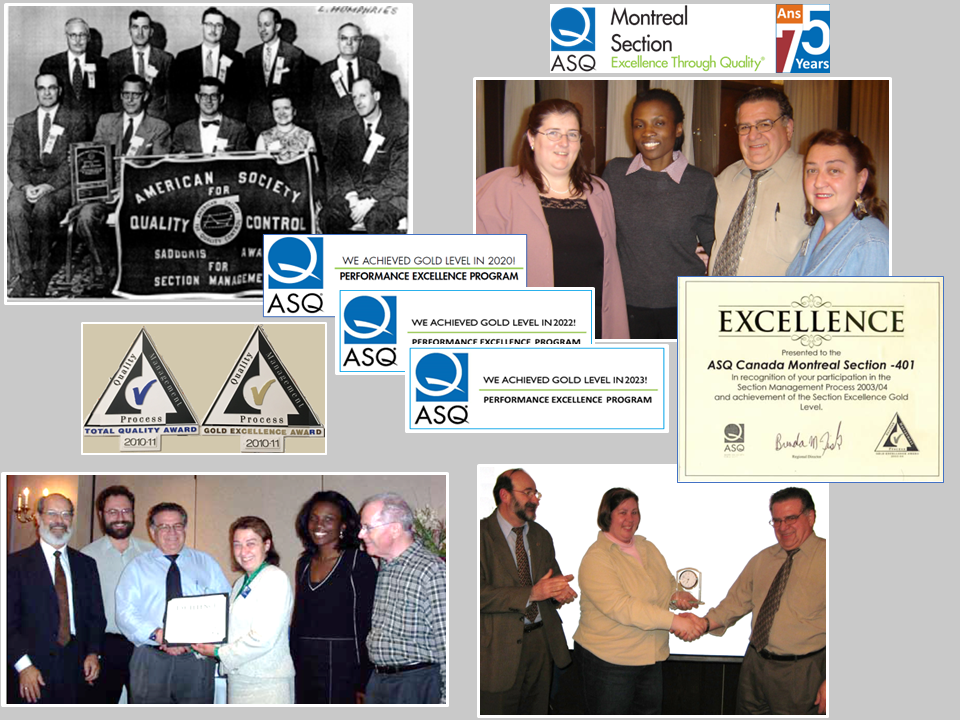
L’ASQ a toujours eu des programmes pour encourager ses sections locales à s’organiser, à établir des plans d’affaires et des objectifs par le biais de défis tels que le prix Saddoris (1958 et 1959, sur 110 sections de l’ASQ), le Processus de gestion des sections (les années 80) et remplacé par le Programme d’excellence en matière de performance au début des années 2010. Tout au long de ses 75 années d’existence, la section de Montréal s’est non seulement lancée des défis, mais elle a aussi remporté diverses reconnaissances à de nombreuses occasions – trophées, certificats et épinglettes, remis en mains propres par des représentants de l’ASQ ou envoyés par la poste. 

ASQ has always had programs to encourage its local sections to organize, set business plans and goals through such challenges as the Saddoris Award (1958 and 1959, of 110 ASQ sections), the Section Management Process (the 1980s) and replaced by the Performance Excellence Program in the early 2010. Throughout our 75 years, the Montreal Section not only challenged itself to participate, but won various achievement recognitions on numerous occasions — Trophies, Certificates and Pins, hand-delivered by ASQ representatives or by mail.  

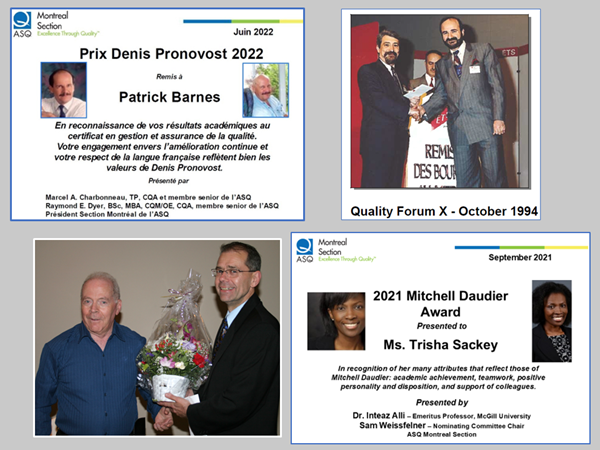
Des prix locaux ont également été créés et décernés en l’honneur de certains anciens leaders de la section, tels qu’Eric Stern, Denis Pronovost et Mitchell Daudier. Ces prix visaient à reconnaître et à promouvoir les valeurs et les réalisations de certains de nos membres d’équipe exceptionnels en identifiant et en attribuant une bourse à un étudiant universitaire dans un domaine lié à la qualité à Concordia, à l’École de technologie supérieure et à McGill

Local awards have also been created and given in honour of some of our past section leaders such as Eric Stern, Denis Pronovost and Mitchell Daudier. These awards were meant to recognize and promote the values and accomplishments of some of our outstanding team members by identifying and giving a bursary to a university student in a quality-related field at Concordia, the École de technologie supérieure and McGill.  

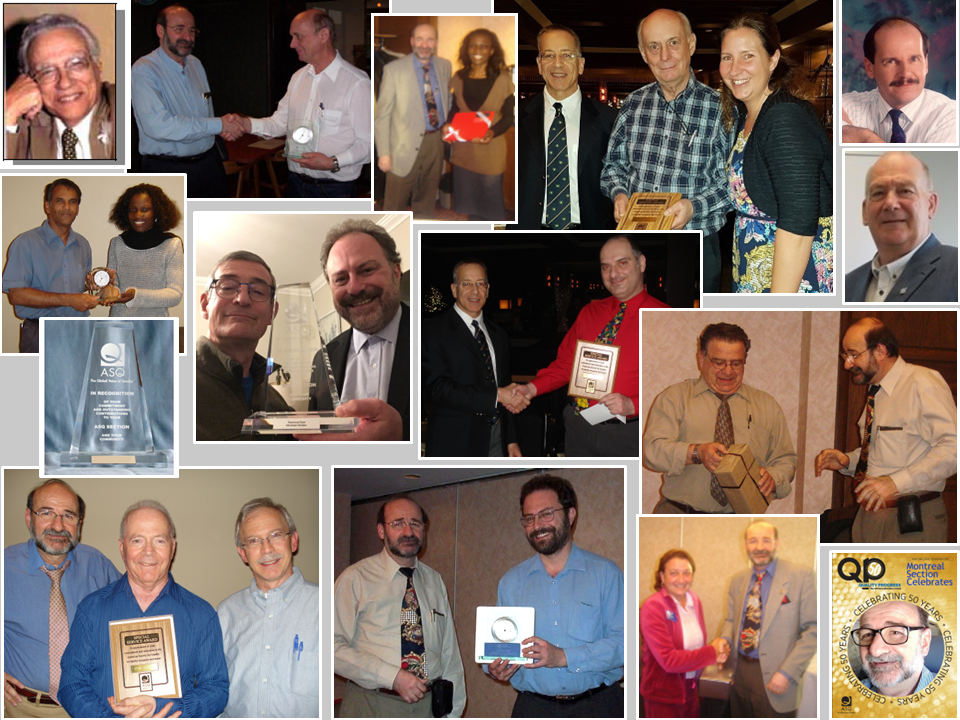
Aussi, le comité exécutif de la section prend aussi régulièrement le temps d’identifier certaines personnes pour leurs réalisations et leurs contributions au succès de la section et remercie également les membres de l’équipe dirigeante lors d’un dîner annuel ou de l’assemblée générale.
Quelques exemples récents: Joseph KELADA (ASQ Fellow), Norman DICKINSON, Michael BOURNAZIAN, Jean-Pierre AMIEL, Raymond DYER, Bernard DOIRON, Sam WEISSFELNER, Veronica MARQUEZ, Chantale SIMARD, Eric STERN, Inteaz ALLI (ASQ Fellow) et Brenda FISK. 

Also, the section executive regularly takes the time to identify certain individuals for their accomplishments and contributions to the success of the section, and also thanks the leadership team members at an annual dinner or at the General Assembly.
Some of the more recent examples: Joseph KELADA (ASQ Fellow), Norman DICKINSON, Michael BOURNAZIAN, Jean-Pierre AMIEL, Raymond DYER, Bernard DOIRON, Sam WEISSFELNER, Veronica MARQUEZ, Chantale SIMARD, Eric STERN, Inteaz ALLI (ASQ Fellow) and Brenda FISK


ASQ Montreal – 75 Years of History – Awards and Recognition | Prix et reconnaissance Read More »

Scroll to Top