Pierre Marquis

Student Outreach | Sensibilisation étudiante (Article 2)

Pierre Marquis, Membership Chair Section Montréal, Student Outreach Committee Member (An English text follows)

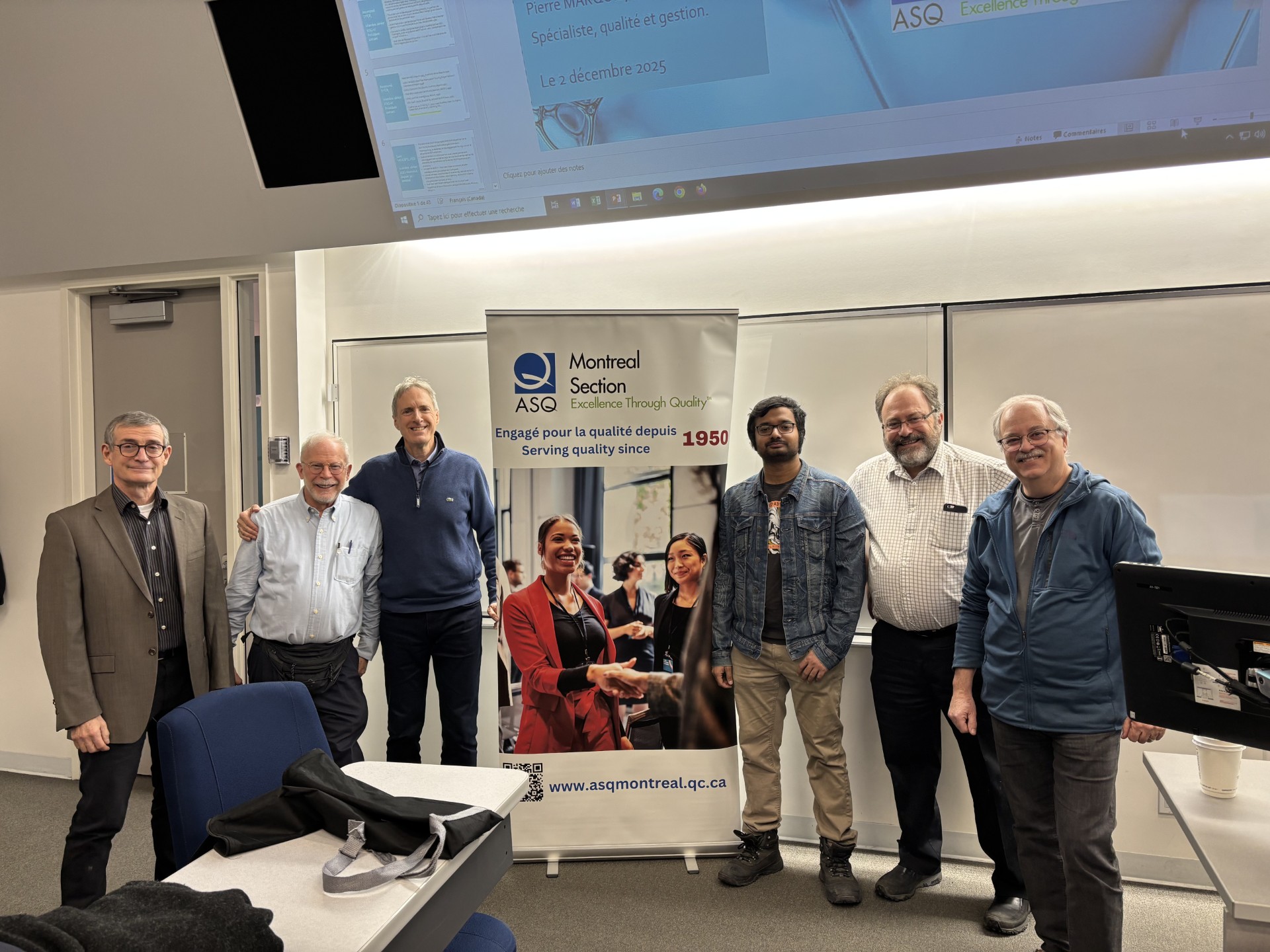
Des présentations sont planifiées en novembre/décembre: HEC Montréal (certificat ou bac, cours de gestion de la qualité), le 20 novembre et 2 decembre. McGill (maîtrise en design durable collaboratif), le 13 novembre.

L’activité suivante a eu lieu le 29 octobre: POLY MTL: “Réseautage, étudiants en génie industriel”

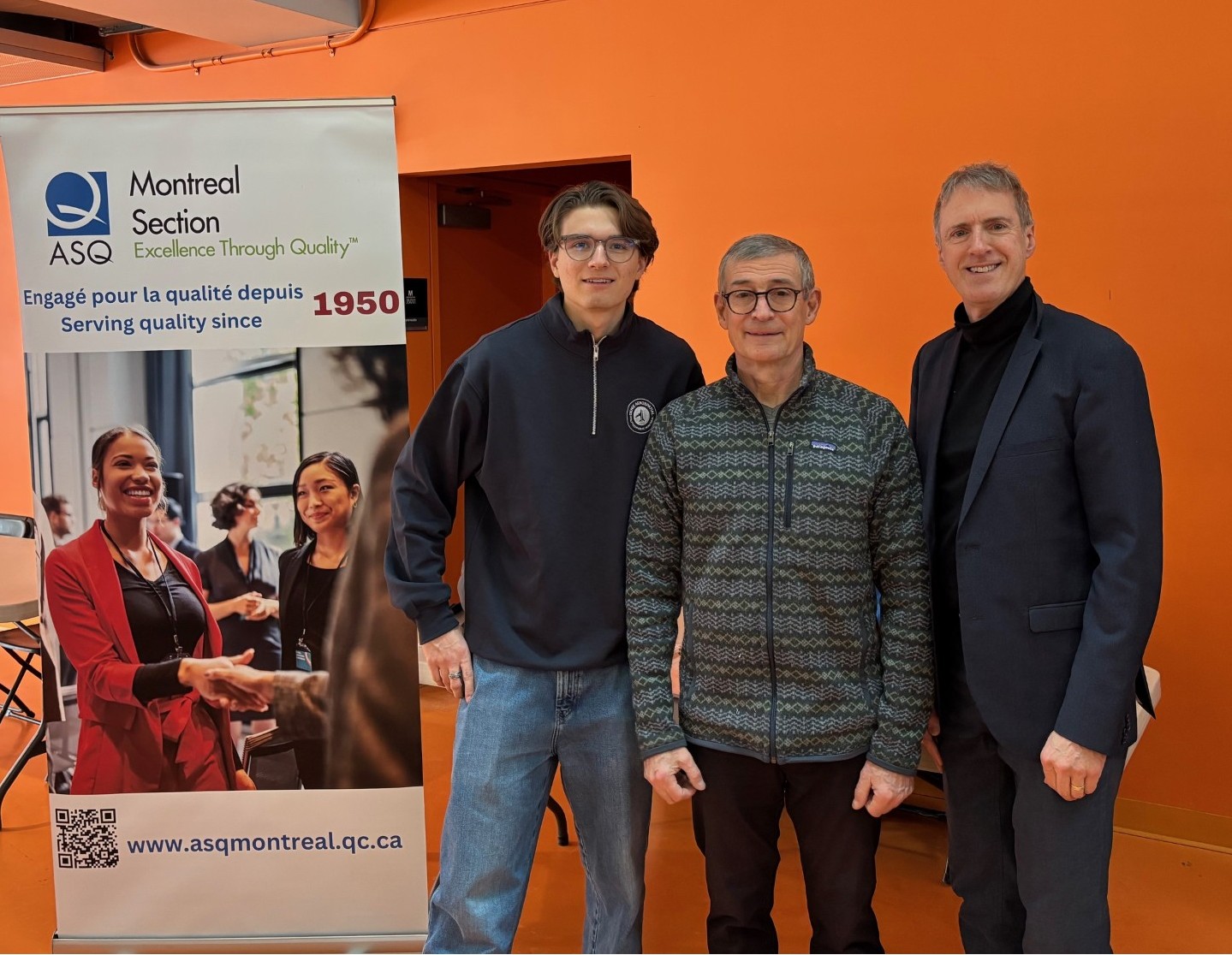
Sur invitation du comité des étudiants en génie industriel (CEGI), ASQ Montréal a été représenté par Eric Hosking et Pierre Marquis; cette soirée de réseautage (18h à 21h), où des employeurs étaient présents, a permis de rencontrer les étudiants de 2e, 3e et 4e années. Plusieurs cours en génie industriel rejoignent la qualité et l’ASQ, tels que la gestion du changement, l’amélioration continue, les méthodes statistiques et l’ingénierie de la qualité. Des étudiants se sont montrés intéressés par les 19 certifications offertes par l’ASQ, les webinaires mensuels et la possibilité de s’impliquer comme bénévole. Le CEGI s’est enquis d’une offre de prestation de Pierre Marquis, bachelier en génie industriel, sur un sujet de leur choix, tel que l’intersection entre l’ingénierie et la qualité.

ACADEMIA:

  • Contactez-nous si vous souhaitez organiser un événement avec vos étudiants et discutons de la manière dont nous pouvons aborder le sujet de la qualité dans le monde universitaire.
  • Si vous faites partie d’un établissement d’enseignement et que vous souhaitez avoir plus de visibilité sur les sujets liés à la qualité, contactez Pierre Marquis sur LinkedIn. Nous disposons d’un réseau de conférenciers potentiels qui pourraient vous intéresser.

Presentations to students are scheduled for November/December: HEC Montreal (certificate or bac, quality management course) on November 20 and December 2. McGill (Master’s in Collaborative Sustainable Design) on November 13.

The following activity took place on October 29: POLY MTL: “Networking, industrial engineering students”

At the invitation of the industrial engineering student committee (CEGI), ASQ Montreal was represented by Eric Hosking and Pierre Marquis. This networking evening (6:00 to 9:00 p.m.), attended by employers, provided an opportunity to meet with second-, third-, and fourth-year students. Several industrial engineering courses are related to quality and ASQ, such as change management, continuous improvement, statistical methods, and quality engineering.  Students expressed interest in the 19 certifications offered by ASQ, the monthly webinars, and the opportunity to get involved as volunteers. CEGI inquired about a presentation by Pierre Marquis, who has a bachelor’s degree in industrial engineering, on a topic of their choice, such as the intersection between engineering and quality.

ACADEMIA:

  • Contact us if you are organizing a student event and wish to discuss how to present quality-related topics in the university.
  • If you are part of an educational institution and would like to have more visibility on quality-related topics, please contact Pierre Marquis on LinkedIn. We have a network of potential speakers that may be of interest to you.


Student Outreach | Sensibilisation étudiante (Article 2) Read More »

Student Outreach | Sensibilisation étudiante (Article 1)

Pierre Marquis, Membership Chair Section Montréal, Student Outreach Committee Member (An English text follows)

RÉSUMÉ DE PRÉSENTATION: CÉGEP AHUNTSIC, TECHNIQUES du GÉNIE INDUSTRIEL, COURS “Normalisation et management de la qualité”

Présentateur: Pierre MARQUIS, responsable de la sensibilisation étudiante.

Le jeudi 30 octobre 2025, Pierre MARQUIS a été reçu par le professeur M. Nicolas VERRON,  pour démystifier ses étudiants de troisième année sur le rôle et les compétences du futur technicien(ne) de la qualité en entreprise.

Les objectifs de la présentation étaient:

  • Pouvoir définir la qualité;
  • Connaître l’existence des normes de qualité ISO;
  • Comprendre l’implication du technicien dans la fonction qualité de la firme (tâches, défis, projets);
  • Identifier les qualités requises d’un technicien en qualité performant;
  • Décrire une journée typique du technicien en qualité;
  • Constater les opportunités d’avancement;
  • Expliquer le déroulement d’un audit qualité;
  • Connaître l’implication de l’IA en qualité;
  • Connaître l’inspection par la Réalité Augmentée;
  • Comprendre l’importance de la sélection/contrôle des fournisseurs;
  • Reconnaître le rôle de l’ASQ.

Les sujets ont été présentés de façon interactive, chacun des quatorze étudiants ayant le visuel devant son écran, sachant que la présentation est disponible pour référence future, comme en 2024. Cette année, la sélection et le contrôle des fournisseurs ont été rajoutés à la demande du professeur, ce qui fut traité en mentionnant les requis d’AS9100 sur le sujet.

Le survol d’ASQ, qui offre 19 certifications en qualité, a été partagé avec intérêt, tout en parlant de la section ASQ Montréal qui existe depuis 1950, des 9 webinaires (ou séminaires) annuels et de la possibilité de réseautage pour les étudiants.

Finalement un étudiant a demandé au présentateur quelle approche prendre pour résoudre un problème? Réponse: “Définit le problème, forme une équipe multi-displinaire incluant les personnes impliquées et assure-toi d’avoir suivi une formation en résolution de problème au préalable.”

ACADEMIA:

  • Contactez-nous si vous souhaitez organiser un événement avec vos étudiants et discutons de la manière dont nous pouvons aborder le sujet de la qualité dans le monde universitaire.
  • Si vous faites partie d’un établissement d’enseignement et que vous souhaitez avoir plus de visibilité sur les sujets liés à la qualité, contactez Pierre Marquis sur LinkedIn. Nous disposons d’un réseau de conférenciers potentiels qui pourraient vous intéresser.

PRESENTATION SUMMARY: AHUNTSIC COLLEGE, INDUSTRIAL ENG. TECHNICIAN, COURSE “Standards and Quality Management”

Presenter: Pierre MARQUIS, Student Outreach Chair.

On Thursday, October 30, 2025, Pierre MARQUIS was welcomed by Professor Nicolas VERRON to demystify the role and skills of future quality technicians in business for his third-year students.

The objectives of the presentation were:

  • To be able to define quality;
  • To learn about the existence of ISO quality standards;
  • To understand the technician’s involvement in the company’s quality function (tasks, challenges, projects);
  • To identify the qualities required of a successful quality technician;
  • To describe a typical day in the life of a quality technician;
  • To identify opportunities for advancement;
  • Explain how a quality audit is conducted;
  • Understand the role of AI in quality;
  • Understand inspection using augmented reality;
  • Understand the importance of supplier selection/control;
  • Recognize the role of ASQ.

The topics were presented interactively, with each of the fourteen students viewing the presentation on their screens, knowing that it would be available for future reference, such as in 2024. This year, supplier selection and control were added at the professor’s request, which was addressed by mentioning the AS9100 requirements on the subject.

The overview of ASQ, which offers 19 quality certifications, was shared with interest, along with information about the ASQ Montreal chapter, which has been in existence since 1950, the nine annual webinars (or seminars), and networking opportunities for students.

Finally, a student asked the presenter what approach to take to solve a problem. The answer: “Define the problem, form a multidisciplinary team including the people involved, and make sure you have undergone problem-solving training beforehand.”

ACADEMIA:

  • Contact us if you are organizing a student event and wish to discuss how to present quality-related topics in the university.
  • If you are part of an educational institution and would like to have more visibility on quality-related topics, please contact Pierre Marquis on LinkedIn. We have a network of potential speakers that may be of interest to you.


Student Outreach | Sensibilisation étudiante (Article 1) Read More »

Si vous étiez présent | Had You Been There

Résumé du webinaire “Getting buy in: Good practices in setting up a Quality Improvement System”

Par Pierre MARQUIS, B.ing./MBA

ASQ Montréal Membership and Student Outreach Chair. Consultant en qualité et productivité (English text follows)

Webinaire organisé par Samira KAZEMI et Raymond DYER, sur la plateforme Zoom. Présentateur: Dr. David TOZER, d’ASQ Montréal.

Le 25 septembre dès 18h30, seize participants ont pris le temps d’assister à un webinaire de 2,5 heures, afin de connaître les bonnes pratiques dans l’implantation d’un Système d’Amélioration de la Qualité (SAQ).

De 18h30 à 19h les participants ont pu réseauter en mode virtuel sous la direction de M. Raymond DYER et de Mme Chantale SIMARD, et rencontrer une partie de l’équipe de leadership d’ASQ Montréal. L’ASQ offre 19 certifications pour les professionnels de la qualité et encourage son code d’éthique. Le sondage d’ouverture, répondu par 13 participants, a révélé leur statut: En majorité membres séniors de l’ASQ, de la région de Montréal et travaillant en qualité manufacturière. L’agenda de la soirée et l’introduction du webinaire ont été présentés par Raymond.

Déroulement, dès 19h:

Après une brève introduction du sujet, le présentateur a su capter l’auditoire en effectuant le premier de trois sondages sur l’efficacité du SAQ dans leur organisation et l’engagement de la haute direction. Les deux autres sondages comportaient des questions sur le Conseil de la qualité (ou l’équivalent), le niveau d’interaction multidisciplinaire, l’efficacité des équipes d’amélioration et la résolution de conflits; la majorité des répondants ont indiqué que des améliorations étaient nécessaires.

Dans les organisations, le Conseil de la qualité est un élément clé. Le Conseil est un agent des propriétaires ou du conseil d’administration. Les participants sont: au moins un membre du conseil d’administration ou le propriétaire, la haute direction, des représentants de fonctions importantes au sein de l’organisation, soit une équipe multidisciplinaire. Par exemple, le Conseil peut être composé du président-directeur général et des directeurs séniors suivants: marketing, conception, production, qualité, achats, ventes et comptabilité.

Ce Conseil est chargé de superviser le système qualité de l’organisation, en mettant particulièrement l’accent sur l’amélioration. L’une des principales voies d’amélioration est l’équipe d’amélioration. Le Conseil suit et soutient toutes les équipes d’amélioration. Le conseil élabore une stratégie qualité assortie d’objectifs marketing et financiers spécifiques qui peuvent être utilisés pour mesurer le succès du système d’amélioration de la qualité.

Deux sessions de discussion en équipe, faites en salle de pause, ont été réalisées sur le sujet du Conseil de la qualité. Les questions à répondre, avec justification, étaient: Qui inclure à la 1ère réunion et quels sujets prioriser à l’agenda. Cela a permis aux participants de simuler la création d’un conseil de la qualité. Une discussion générale a suivi, avec le résumé des réponses.

Conclusion:

Pour assurer le succès d’un SAQ, les organisations doivent obtenir l’engagement de la haute direction, implanter un Conseil de la qualité multidisciplinaire et faire participer toute l’organisation.

L’audience du webinaire a été très satisfaite de la qualité de la présentation et du degré d’interaction entre les participants. Les résultats du sondage de la fin témoignent de la satisfaction des répondants, avec un résultat global de satisfaction de 4.7/5.

Pour terminer, Samira a annoncé les dates pour les deux prochaines rencontres: 22 octobre en présentiel au Novotel Montréal Aéroport pour le 75e anniversaire d’ASQ Montréal (réservé aux membres) et le 26 novembre en virtuel: Qualité sans frontières avec ASQ d’Afrique. Raymond a sincèrement remercié David pour sa prestation et les participants pour leur présence active.


WEBINAR SUMMARY “Getting Buy In: Good Practice in Setting Up a Quality Improvement System (QIS)”

Organized by Samira KAZEMI and Raymond DYER, on the Zoom platform. Presenter: Dr. David TOZER from ASQ Montreal.

On September 25, starting at 6:30 p.m., sixteen participants took the time to attend a 2.5-hour webinar to learn about best practices in implementing a Quality Improvement System (QIS).

From 6:30 p.m. to 7 p.m., participants were able to network virtually under the guidance of Mr. Raymond DYER and Ms. Chantale SIMARD, and meet some of the ASQ Montreal Leadership Team. The ASQ offers 19 certifications for quality professionals and promotes its code of ethics. The opening survey, completed by 13 participants, revealed their status: the majority were senior members of ASQ, from the Montreal area, and working in manufacturing quality. The evening’s agenda and introduction to the webinar were presented by Raymond.

Presentation from 7 p.m.:

After a brief introduction to the topic, the presenter captured the audience’s attention by conducting the first of three surveys on the effectiveness of the QIS in their organization and the commitment of top management. The other two surveys included questions about the Quality Council (or equivalent), the level of multidisciplinary interaction, the effectiveness of improvement teams and conflict resolution; most respondents indicated that improvements were needed.

The Quality Council is a key element in organizations. The Council is an agent of the owners or the board of directors. Participants include at least one member of the board of directors or the owner, senior management, representatives of important functions within the organization, or a multidisciplinary team. For example, the Council may be composed of the CEO and the following senior managers: marketing, design, production, quality, purchasing, sales, and accounting.

This Council is responsible for overseeing the organization’s quality system, with a particular focus on improvement. One of the main avenues for improvement is the improvement team. The Council monitors and supports all improvement teams. The Council develops a quality strategy with specific marketing and financial objectives that can be used to measure the success of the quality improvement system.

Two team discussion sessions, held in the break room, were conducted on the topic of the Quality Council. The questions to be answered, with justification, were: Who to include in the first meeting and what topics to prioritize on the agenda. This allowed participants to simulate the creation of a Quality Council. A general discussion followed, with a summary of the responses.

Conclusion:

To ensure the success of a QIS, organizations must obtain top management commitment, establish a multidisciplinary Quality Council, and involve the entire organization.

The webinar audience was very satisfied with the quality of the presentation and the level of interaction among participants. The results of the end-of-webinar survey reflect the respondents’ satisfaction, with an overall satisfaction rating of 4.7/5.

Finally, Samira announced the dates for the next two meetings: October 22 in person at the Novotel Montreal Airport for the 75th anniversary of ASQ Montreal (members only) and November 26 virtually: Quality Without Borders with ASQ Africa. Raymond sincerely thanked David for his presentation and the attendees for their active participation.

Si vous étiez présent | Had You Been There Read More »

Student Outreach | Sensibilisation étudiante

Pierre Marquis, Membership Chair Section Montréal, Student Outreach Committee Member (An English text follows)

RÉSUMÉ DE PRÉSENTATION: CÉGEP AHUNTSIC, TECHNIQUES du GÉNIE INDUSTRIEL,  COURS ‘Normalisation et management de la qualité’

Présentateur : Pierre MARQUIS, responsable de la sensibilisation étudiante.

Le jeudi 30 octobre 2025, Pierre MARQUIS a été reçu par le professeur M. Nicolas VERRON,  pour démystifier ses étudiants de troisième année sur le rôle et les compétences du futur technicien(ne) de la qualité en entreprise.

Les objectifs de la présentation étaient:

  • Pouvoir définir la qualité;
  • Connaître l’existence des normes de qualité ISO;
  • Comprendre l’implication du technicien dans la fonction qualité de la firme (tâches, défis, projets);
  • Identifier les qualités requises d’un technicien en qualité performant;
  • Décrire une journée typique du technicien en qualité;
  • Constater les opportunités d’avancement;
  • Expliquer le déroulement d’un audit qualité;
  • Connaître l’implication de l’IA en qualité;
  • Connaître l’inspection par la Réalité Augmentée;
  • Comprendre l’importance de la sélection/contrôle des fournisseurs;
  • Reconnaître le rôle de l’ASQ.

Les sujets ont été présentés de façon interactive, chacun des quatorze étudiants ayant le visuel devant son écran, sachant que la présentation est disponible pour référence future, comme en 2024. Cette année, la sélection et le contrôle des fournisseurs ont été rajoutés à la demande du professeur, ce qui fut traité en mentionnant les requis d’AS9100 sur le sujet.

Le survol d’ASQ, qui offre 19 certifications en qualité, a été partagé avec intérêt, tout en parlant de la section ASQ Montréal qui existe depuis 1950, des 9 webinaires (ou séminaires) annuels et de la possibilité de réseautage pour les étudiants.

Finalement un étudiant a demandé au présentateur quelle approche prendre pour résoudre un problème? Réponse : ‘Définit le problème, forme une équipe multi-displinaire incluant les personnes impliquées et assure-toi d’avoir suivi une formation en résolution de problème au préalable.’

ACADEMIA:

  • Contactez-nous si vous souhaitez organiser un événement avec vos étudiants et discutons de la manière dont nous pouvons aborder le sujet de la qualité dans le monde universitaire.
  • Si vous faites partie d’un établissement d’enseignement et que vous souhaitez avoir plus de visibilité sur les sujets liés à la qualité, contactez Pierre Marquis sur LinkedIn. Nous disposons d’un réseau de conférenciers potentiels qui pourraient vous intéresser.

PRESENTATION SUMMARY: AHUNTSIC COLLEGE, INDUSTRIAL ENG. TECHNICIAN,  COURSE ‘Standards and Quality Management’

Presenter: Pierre MARQUIS, Student Outreach Chair.

On Thursday, October 30, 2025, Pierre MARQUIS was welcomed by Professor Nicolas VERRON to demystify the role and skills of future quality technicians in business for his third-year students.

The objectives of the presentation were:

  • To be able to define quality;
  • To learn about the existence of ISO quality standards;
  • To understand the technician’s involvement in the company’s quality function (tasks, challenges, projects);
  • To identify the qualities required of a successful quality technician;
  • To describe a typical day in the life of a quality technician;
  • To identify opportunities for advancement;
  • Explain how a quality audit is conducted;
  • Understand the role of AI in quality;
  • Understand inspection using augmented reality;
  • Understand the importance of supplier selection/control;
  • Recognize the role of ASQ.

The topics were presented interactively, with each of the fourteen students viewing the presentation on their screens, knowing that it would be available for future reference, such as in 2024. This year, supplier selection and control were added at the professor’s request, which was addressed by mentioning the AS9100 requirements on the subject.

The overview of ASQ, which offers 19 quality certifications, was shared with interest, along with information about the ASQ Montreal chapter, which has been in existence since 1950, the nine annual webinars (or seminars), and networking opportunities for students.

Finally, a student asked the presenter what approach to take to solve a problem. The answer: “Define the problem, form a multidisciplinary team including the people involved, and make sure you have undergone problem-solving training beforehand.”

ACADEMIA:

  • Contact us if you are organizing a student event and wish to discuss how to present quality-related topics in the university.
  • If you are part of an educational institution and would like to have more visibility on quality-related topics, please contact Pierre Marquis on LinkedIn. We have a network of potential speakers that may be of interest to you.


Student Outreach | Sensibilisation étudiante Read More »

Student Outreach | Sensibilisation étudiante

Pierre Marquis, Membership Chair Section Montréal, Student Outreach Committee Member (An English text follows)

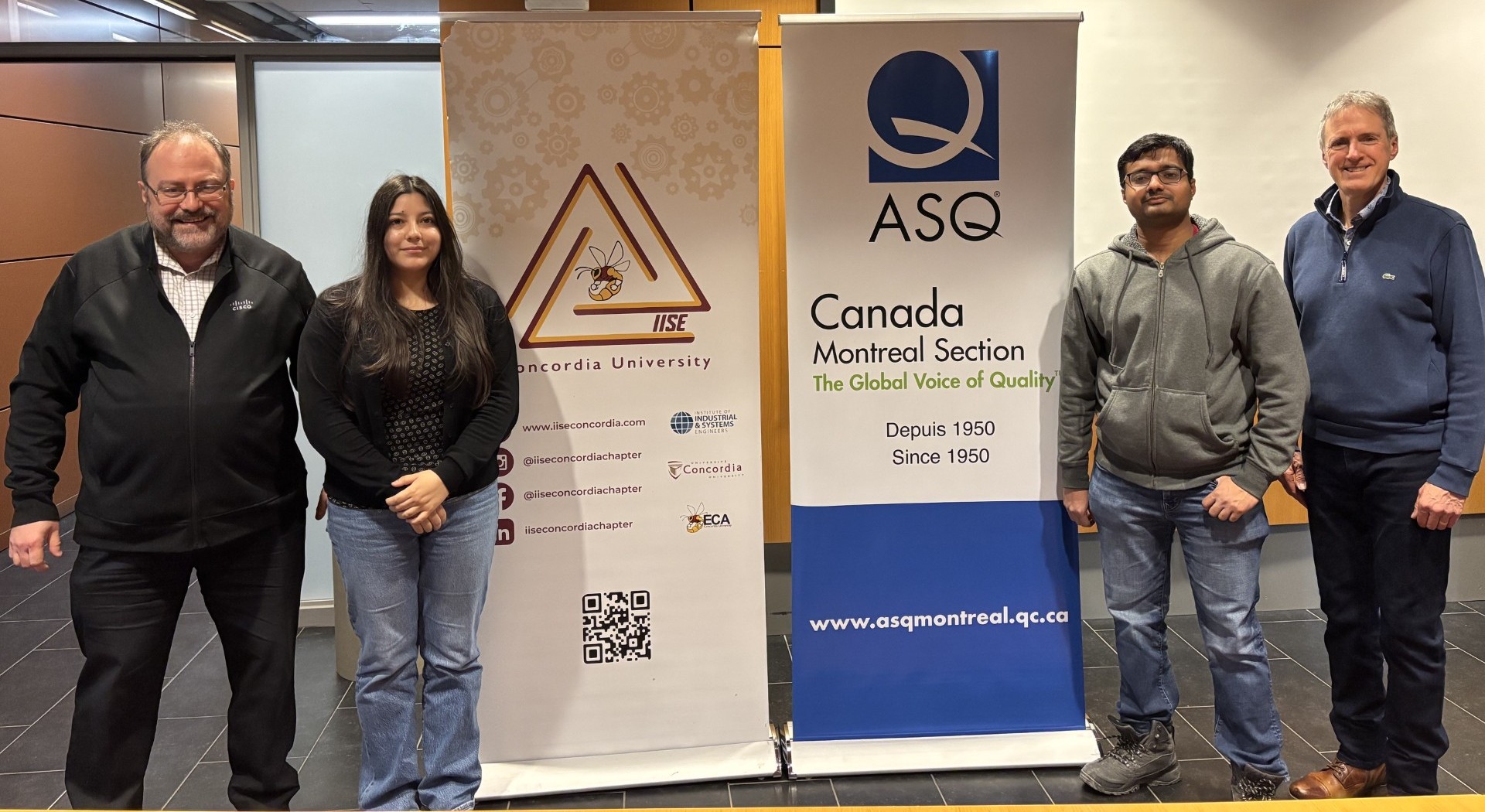
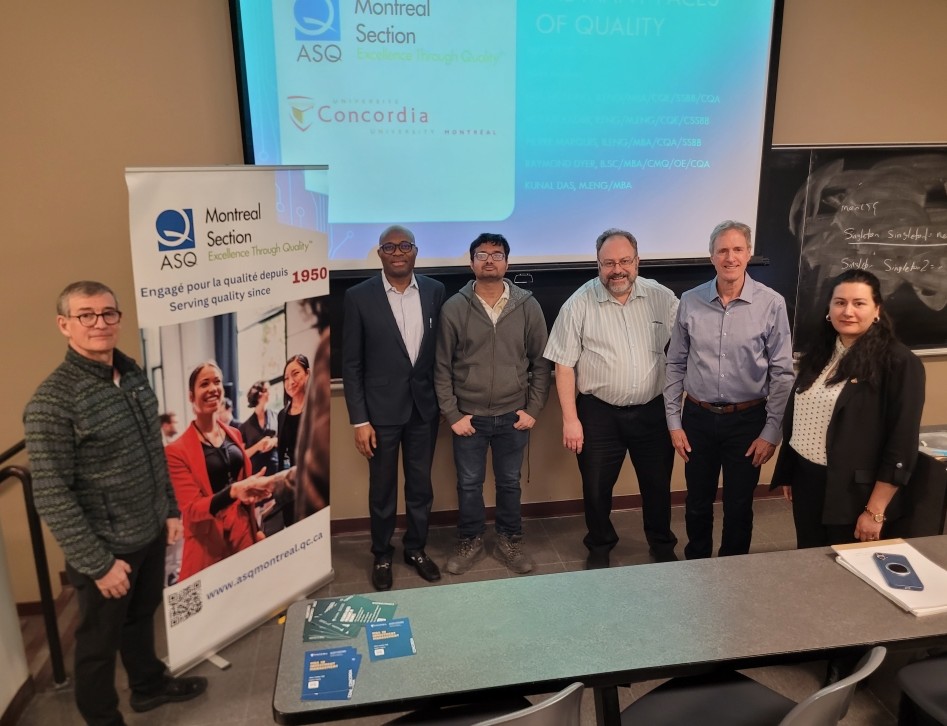
Le 25 septembre nous organisons à Concordia, un panel de discussion intitulé “Les multiples visages de la qualité”. On recherche des volontaires (membres ASQ sénior) pour y participer, de 10h à midi – SVP m’envoyer un courriel si intéressé (détails ici-bas, no. 4). Le 30 octobre, Pierre Marquis va rencontrer les étudiants du CEGEP Ahuntsic en techniques du génie industriel, dans le cours “Normalisation et management de la qualité”. Cet événement a été fait à l’automne 2024, avec succès.

D’autres présentations sont prévues cet automne ou à l’hiver 2026, aux HEC, Concordia et UQAM.

J’en profite pour inviter toute la communauté étudiante et les professeurs à me solliciter pour vous rencontrer à votre université/CÉGEP et discuter “Qualité”, avec mes collègues Raymond Dyer, Eric Hosking et Sam Weissfelner, qui m’ont accompagné dans le passé. Un choix de quatre thèmes est proposé: 

1 – L’intersection de l’ingénierie et de la qualité (ou de la gestion et de la qualité): Illustrer le rôle prépondérant des ingénieurs/gestionnaires dans l’empreinte qualité des produits manufacturés.

2 – Les futurs talents de la qualité: Un panel de trois ou quatre professionnels partageant leur vision de l’avenir de la profession de la qualité.

3 – Panel Six Sigma: Un panel d’experts de l’industrie dans la mise en œuvre de programmes six sigma et l’utilisation d’outils six sigma présentent une brève vue d’ensemble de leur expérience avec six sigma.

4 – Les multiples visages de la qualité: Des professionnels de la qualité, issus d’un large éventail d’industries et de disciplines, parlent de leurs débuts, leur développement professionnel et de leurs activités dans le domaine de la qualité, accompagné d’anecdotes.

Notez que tout autre demande précise sera aussi considérée, en plus de ces quatre choix. Simplement m’envoyer un courriel à pierre.marquis1@gmail.com avec les détails.

Merci de votre attention!

ACADEMIA:

  • Contactez-nous si vous souhaitez organiser un événement avec vos étudiants et discutons de la manière dont nous pouvons aborder le sujet de la qualité dans le monde universitaire.
  • Si vous faites partie d’un établissement d’enseignement et que vous souhaitez avoir plus de visibilité sur les sujets liés à la qualité, contactez Pierre Marquis sur LinkedIn. Nous disposons d’un réseau de conférenciers potentiels qui pourraient vous intéresser.

On September 25th at Concordia University, we are having a discussion panel called “The Many Faces of Quality”. We need volunteers (senior ASQ members) to participate, from 10am to noon – please send me an email if interested (details below, no. 4). On October 30th, Pierre Marquis will meet with industrial engineering students at CEGEP Ahuntsic as part of the “Standardization and Quality Management” course. This event was successfully held in the fall of 2024.

Other presentations are planned for this Fall or Winter 2026 at HEC, Concordia, and UQAM.

I would like to take this opportunity to invite the entire student community and professors to contact me to meet at your university/CEGEP and discuss “Quality” with my colleagues Raymond Dyer, Eric Hosking and Sam Weissfelner, who have accompanied me in the past. A choice of four themes is proposed:

1 – The intersection of engineering and quality (or management and quality): To illustrate the key role of engineers/managers in the quality footprint of manufactured products.

2 – Future Quality Talent: A panel of three or four professionals share their vision of the future of the quality profession.

3 – Six Sigma Panel: A panel of industry experts in the implementation of Six Sigma programs and the use of Six Sigma tools present a brief overview of their experience with Six Sigma.

4 – The Many Faces of Quality: Quality professionals from a wide range of industries and disciplines talk about their beginnings, their professional development, and their activities in the field of quality, accompanied by anecdotes.

Please note that any other specific requests will also be considered, in addition to these four choices. Simply send me an email at pierre.marquis1@gmail.com with the details.

Thank you for your attention!

ACADEMIA:

  • Contact us if you are organizing a student event and wish to discuss how to present quality-related topics in the university.
  • If you are part of an educational institution and would like to have more visibility on quality-related topics, please contact Pierre Marquis on LinkedIn. We have a network of potential speakers that may be of interest to you.


Student Outreach | Sensibilisation étudiante Read More »

Si vous étiez présent | Had You Been There

RÉSUMÉ DU WEBINAIRE “Two Sides of the Same Coin: ISO/IEC 42001 & 27001”
(WEBINAR SUMMARY “’Two Sides of the Same Coin: ISO/IEC 42001 & 27001 ”)

Par Pierre MARQUIS, Membership Chair Section Montréal, Student Outreach Committee Member (English text follows)

Organisé par Samira KAZEMI et Ray DYER, sur la plateforme Zoom.

Présentateur: M. Petru DRAGNEF de la firme Seratos Conseil.

Début:

Le 28 mai 2025 dès 18h30, trente-six participants ont eu le privilège d’assister à un webinaire de 2.5 heures, afin de démystifier les standards sur l’IA (ISO 42001) et la sécurité informatique (ISO 27001).

De 18h30 à 19h les participants ont pu réseauter sous la direction de M. Ray DYER, et rencontrer une partie de l’équipe de leadership d’ASQ Montréal. L’ASQ offre 19 certifications pour les professionnels de la qualité et encourage son code d’éthique. Le sondage d’ouverture, répondu par 26 participants, a révélé leur statut: plus de la moitié étaient non-membres de l’ASQ, ce qui est inhabituel. 14/26 de la région de Montréal et des représentants de l’Ontario, C-B et USA. L’agenda de la soirée a été présenté par Ray et l’introduction du webinaire par Samira KAZEMI.

Presentation, dès 19h:

Intro par M. Petru DRAGNEF: Auditeur principal ISO 27001, avec bac en math et philosophie, 11 années d’expérience à Seratos Conseil, qui offre des services de qualité en matière de sécurité et de gestion des risques, pour un large éventail d’industries et de normes. Sa collaboratrice, Mme Julianna El-Sabeh, MBA et directrice du développement des affaires, était aussi présente au webinaire.

Les objectifs étaient de comprendre les similitudes et les différences entre les standards ISO 27001 et ISO/IEC 42001. Un premier sondage sur la familiarité des participants avec les normes a révélé que, par exemple, 48% étaient non-familiers avec ISO 27001, alors que pour ISO 42001 c’était 84%. Le 2e sondage portait sur la meilleure équipe pour implanter la norme et celle qui en bénéficierait le plus; la haute direction a été nommée majoritairement, dans les deux cas.

Les deux standards utilisent la mème structure harmonisée des systèmes de management de la qualité, basés sur l’approche d’évaluation des risques et les contrôles de l’annexe A. Le présentateur a identifié, avec 4 codes de couleur, les similitudes et les particularités de chacun. Par exemple, seule ISO 42001 exige une analyse d’impact sur le système d’IA, au point 8.4, codé en jaune. La norme ISO 22989 est la référence normative pour ISO 42001; une entreprise qui est déjà certifiée ISO 27001 possède une bonne base pour implanter 42001. Les étapes d’implantation de ces normes ont été expliquées par M. Dragnef.

L’audience a participé à une session de discussion sur les risques, par équipe et en salle de pause, pour 3 types d’organisation: services financiers, logiciels et manufacturier; la conclusion fut que l’analyse des risques est spécifique à chaque organisation. Une discussion générale a suivi, avec le résumé des sessions. Des exemples d’implication de l’IA et de la sécurité informatique ont été mentionnés, tels que l’analyse des données financières des clients dans les services financiers et l’utilisation des PII (Informations Personnelles Identifiables) dans les logiciels.

Conclusion:

Les organisations doivent comprendre l’importance de bien structurer leurs systèmes de gestion de la sécurité informatique et de l’IA, pour évoluer dans l’environnement actuel des affaires en identifiant et prévenant les risques qui menacent la continuité des opérations.

L’audience du webinaire a été très satisfaite de la qualité de la présentation et de la période de questions qui a suivi, que notre animateur a géré habilement. Les résultats du sondage de la fin témoignent de la satisfaction des répondants, avec un résultat global de satisfaction de 96%.

Pour terminer, Samira a annoncé les dates pour les trois prochaines rencontres, soit le 18 juin (présentiel au Novotel Dorval), le 24 septembre (virtuel, Bonnes Pratiques), le 18 octobre (75e anniversaire d’ASQ Montréal) et le 26 novembre (Qualité sans frontières). Ray a sincèrement remercié Petru pour sa prestation et les nombreux participants pour leur présence active.


Organized by Samira KAZEMI and Ray DYER, on the Zoom platform.

Presenter: Mr. Petru DRAGNEF of the company Seratos Conseil.

Beginning:

On May 28, 2025, starting at 6:30pm, thirty-six participants had the privilege of attending a 2.5-hour webinar to demystify the standards on AI (ISO 42001) and IT security (ISO 27001).

From 6:30 – 7pm, participants were able to network under the guidance of Mr. Ray DYER, and meet part of the ASQ Montreal leadership team. ASQ offers 19 certifications for quality professionals and promotes its code of ethics. The opening survey, completed by 26 participants, revealed their status: more than half were non-members of ASQ, which is unusual. 14/26 from the Montreal region and representatives from Ontario, BC and the USA. The evening’s agenda was presented by Ray and the webinar introduction by Samira KAZEMI.

Presentation, from 7pm:

Intro by Mr. Petru DRAGNEF: ISO 27001 Lead auditor, with a bachelor’s degree in math and philosophy, 11 years’ experience at Seratos Conseil, which provides quality security and risk management services for a wide range of industries and standards. His collaborator, Ms. Julianna El-Sabeh, MBA and Director of Business Development, was also present at the webinar.

The objectives were to understand the similarities and differences between ISO 27001 and ISO/IEC 42001. An initial survey of participants’ familiarity with the standards revealed that, for example, 48% were unfamiliar with ISO 27001, whereas for ISO 42001 it was 84%. The 2nd survey looked at who would be the best team to implement the standard, and who would benefit most from it; top management was overwhelmingly named in both cases.

Both standards use the same harmonized quality management system structure, based on the risk assessment approach and Annex A controls. Using 4 color codes, the presenter identified the similarities and particularities of each. For example, only ISO 42001 requires an impact analysis on the AI system, in point 8.4, color-coded yellow. ISO 22989 is the normative reference for ISO 42001; a company that is already ISO 27001 certified has a good basis for implementing 42001. The steps involved in implementing this were explained by Mr. Dragnef.

The audience took part in a breakout session on risk, in teams, for 3 types of organization: financial services, software and manufacturing; the conclusion was that risk analysis is specific to each organization. A general discussion followed, with summaries of the sessions. Examples of the involvement of AI and IT security were mentioned, such as the analysis of customer financial data in financial services and the use of PII (Personally Identifiable Information) in software.

Conclusion:

Organizations need to understand the importance of properly structuring their IT security and AI management systems, to evolve in today’s business environment by identifying and preventing risks that threaten business continuity.

The webinar audience was very satisfied with the quality of the presentation and the question period that followed, which our moderator skillfully managed. The results of the survey at the end testify to the satisfaction of the respondents, with an overall satisfaction score of 96%.

In closing, Samira announced the dates for the next three events: June 18 (face-to-face at Novotel Dorval), September 24 (virtual, Best Practices), October 18 (ASQ Montreal’s 75th anniversary) and November 26 (Quality Without Borders). Ray sincerely thanked Petru for his performance and the many participants for their active attendance.

Si vous étiez présent | Had You Been There Read More »

Student Outreach | Sensibilisation étudiante

Pierre Marquis, Membership Chair Section Montréal, Student Outreach Committee Member (An English text follows)

Notre comité de sensibilisation des étudiants sera de retour en septembre 2025. Restez à l’écoute.

ACADEMIA:

  • Contactez-nous si vous souhaitez organiser un événement avec vos étudiants et discutons de la manière dont nous pouvons aborder le sujet de la qualité dans le monde universitaire.
  • Si vous faites partie d’un établissement d’enseignement et que vous souhaitez avoir plus de visibilité sur les sujets liés à la qualité, contactez Pierre Marquis sur LinkedIn. Nous disposons d’un réseau de conférenciers potentiels qui pourraient vous intéresser.

Our Student Outreach Committee will be back in September 2025. Stay tuned.

ACADEMIA:

  • Contact us if you are organizing a student event and wish to discuss how to present quality-related topics in the university.
  • If you are part of an educational institution and would like to have more visibility on quality-related topics, please contact Pierre Marquis on LinkedIn. We have a network of potential speakers that may be of interest to you.


Student Outreach | Sensibilisation étudiante Read More »

Scroll to Top