Student Outreach | Sensibilisation étudiante

Pierre Marquis, Membership Chair Section Montréal, Student Outreach Committee Member (An English text follows)

Activités de sensibilisation des étudiants – mars et avril 2026

Après un mois de février sans activité du comité, nous serons présents à deux activités en mars et une autre en avril.

Le 26 mars, Hani Antar va rencontrer des étudiants de l’UQAM ESG dans le cours de consultation et pratique du management; invité par la professeure, il aura l’opportunité de raconter des anecdotes comme consultant et de parler des avantages à être membre étudiant d’ASQ Montréal.

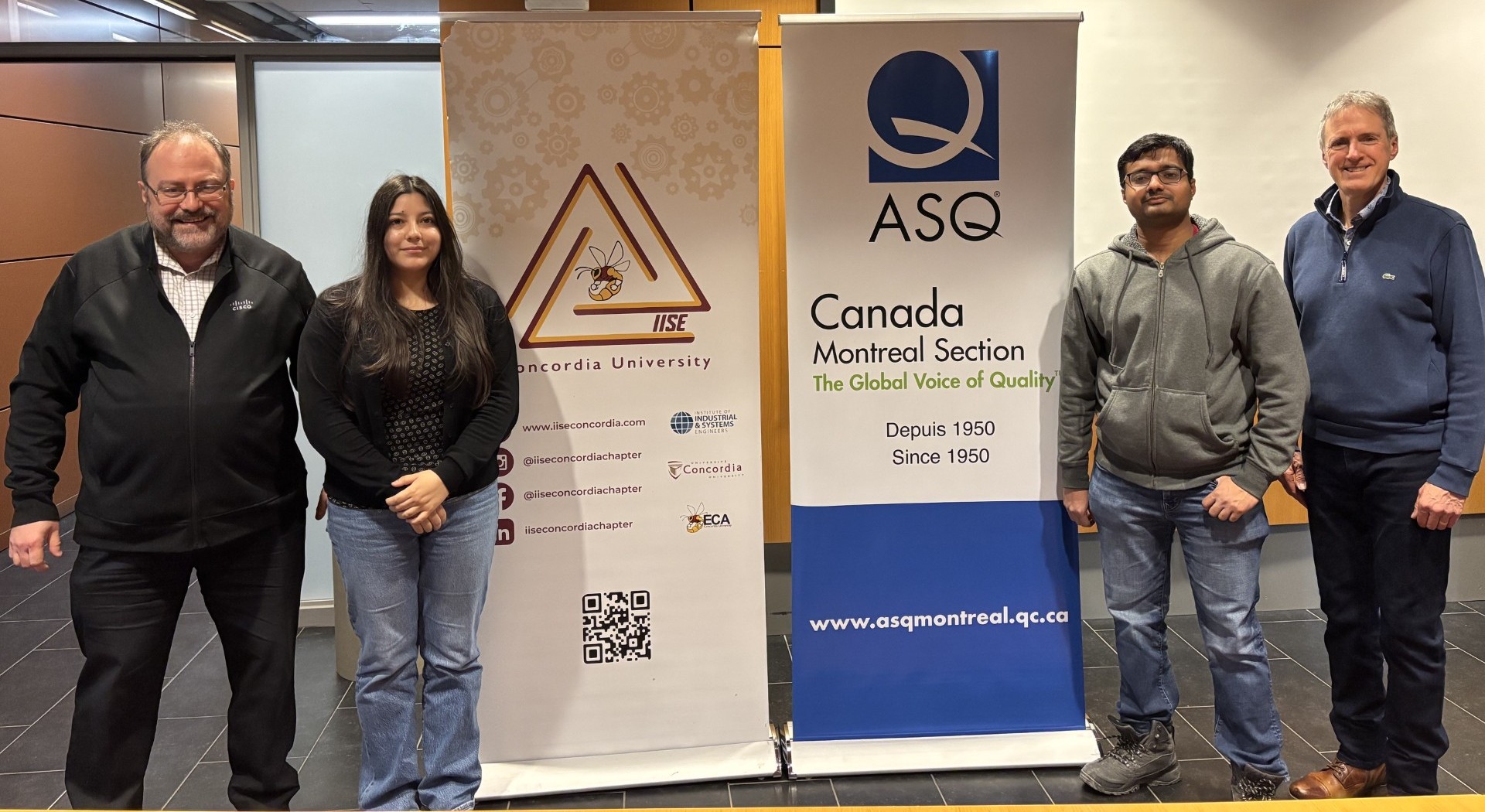
Le 26 mars en soirée, Raymond Dyer et Eric Hosking iront à Concordia pour du réseautage avec les étudiants en génie industriel, organisé par le chapitre étudiant d’IISE (Institute of Industrial and Systems Engineers).

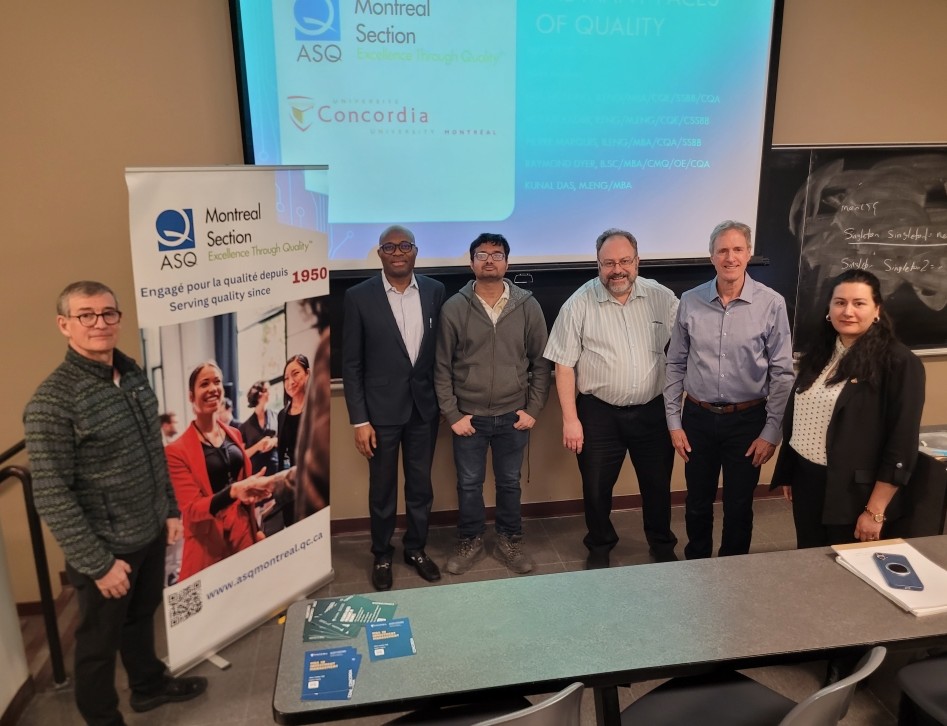
Le 30 avril à Concordia, un panel d’expert (membres séniors d’ASQ Mtl) seront invités à raconter leur parcours académique et professionnel dans le cadre d’un cours sur la qualité donné par la professeure, selon la formule “Les multiples facettes de la qualité”.

ACADEMIA:

  • Contactez-nous si vous souhaitez organiser un événement avec vos étudiants et discutons de la manière dont nous pouvons aborder le sujet de la qualité dans le monde universitaire.
  • Si vous faites partie d’un établissement d’enseignement et que vous souhaitez avoir plus de visibilité sur les sujets liés à la qualité, contactez Pierre Marquis sur LinkedIn. Nous disposons d’un réseau de conférenciers potentiels qui pourraient vous intéresser.

Student Outreach Activities – March and April 2026

After no activity held by the committee in February, we will be present at two events in March and at another one in April.

On March 26, Hani Antar will meet students at ESG UQAM during the course entitled “Consultation et pratique du management”; invited by the teacher, he will have the opportunity to tell stories as a consultant and to talk about the benefits of being a student member of ASQ Montreal.

On the evening of March 26, Raymond Dyer and Eric Hosking will be at Concordia for networking with industrial engineering students, organized by their IISE chapter (Institute of Industrial and Systems Engineers).

On April 30 at Concordia, an expert panel (senior members of ASQ Montreal) will be present to explain their academic and professional career path during a course on Quality, as invited by the teacher; the event is entitled “The Many Faces of Quality”.

ACADEMIA:

  • Contact us if you are organizing a student event and wish to discuss how to present quality-related topics in the university.
  • If you are part of an educational institution and would like to have more visibility on quality-related topics, please contact Pierre Marquis on LinkedIn. We have a network of potential speakers that may be of interest to you.


Student Outreach | Sensibilisation étudiante Read More »

Mot de la présidente | Word from the Chair

Par Chantale Simard, MBA, ASQ Senior Member, CSSGB (English text follows)

Avec l’arrivée du printemps, c’est souvent un moment où l’on prend un peu de recul pour réfléchir à ce que l’on souhaite améliorer ou faire évoluer.

Le monde de la qualité est en constante évolution. Les nouvelles technologies, les attentes des clients et la complexité croissante des organisations nous amènent à adapter nos pratiques et à apprendre continuellement. C’est ce qui rend notre domaine si stimulant.

L’une des grandes forces de l’ASQ Montréal est justement de permettre ces échanges entre professionnels de la qualité. Nos événements et nos activités sont des occasions de partager des expériences, de découvrir de nouvelles idées et de rester connectés avec notre communauté.

Au cours des prochains mois, nous continuerons à vous proposer des conférences, des rencontres et des occasions de réseautage pour soutenir le développement de notre communauté.

J’espère avoir l’occasion de vous croiser lors d’un de nos prochains événements.

Envoyez-moi vos commentaires


With the arrival of spring, it is often a good time to step back and reflect on what we would like to improve or evolve.

The world of quality is constantly evolving. New technologies, changing customer expectations, and the growing complexity of organizations require us to continuously adapt our practices and keep learning. This is what makes our field so stimulating.

One of the great strengths of ASQ Montréal is the opportunity it provides for exchanges among quality professionals. Our events and activities create opportunities to share experiences, discover new ideas, and stay connected with our community.

In the coming months, we will continue to offer conferences, meetings, and networking opportunities to support the development of our community.

I look forward to seeing many of you at one of our upcoming events.

Send me your comments


Suivez-nous sur LinkedIn

Explorez NOTRE site myASQ Montréal |  Explore OUR Montreal myASQ site.

Mot de la présidente | Word from the Chair Read More »
ASQ Montreal Section – Education Program 2026

Dr David TozerBy Dr. David Tozer, Ph.D., ASQ CQE and SSBB, Education & Audit Chair.

Having ASQ certification gives you an edge in the market and can significantly increase your income.

ASQ Certification often leads to higher paying employment.  The money invested in education and certification increases chances of finding employment quickly in the downsizing environment we live in.

For advice on the program, contact David Tozer at davidtozer@qualitiqua.com or call 514-694-2830.

The following is a list of the certifications and some of the topics covered.

Certified Quality Engineer: Topics include: quality concepts, cost of quality, human resources, team formation and group dynamics, inspection, metrology, sampling, reliability, quality standards, quality audit, statistics, design of experiments, process improvement, liability, and modern management methods for improving quality.

Certified Reliability Engineer: Topics include: reliability management, probability and statistics, modelling and prediction, data collection and analysis, design for reliability, maintainability and availability, reliability testing, product safety and liability.

Certified Software Quality Engineer: Topics include: cost of quality and return on investment, team formation and group dynamics, Life Cycles and Process Models, Systems Architecture, Requirements Engineering, Requirements Management, Audits, Maintenance Management, Software Analysis, Tracking and Controlling, Risk Management, Process and Product Measurement, Analysis and Reporting Techniques, Software Verification and Validation, Software Configuration Management.

 Certified Quality Inspector: Topics include: quality concepts, team formation and group dynamics, geometry, metrology, reading drawings, mechanical processes, statistical process control, inspection, and sampling.

Certified Quality Technician: Topics include: quality concepts, team formation and group dynamics, planning for sampling, problem solving, procedure and instruction preparation, statistical methods, cost of quality.

Certified Calibration Technician: Topics include: testing, calibration, repair, maintenance, environment, electrical, mechanical and electro-mechanical equipment.

Certified Quality Improvement Associate: Topics include: quality tools, improvement projects and teams.

Certified Quality Process Analyst: Topics include: problem solving methods, quality tools, improvement projects and teams,

Certified Master Black Belt: Requirements: Many years experience at the Six Sigma Black Belt level, portfolio of achievements, demonstration of practice and advancing the quality field.

Certified Six Sigma Black Belt: Topics include: quality concepts, cost of quality, enterprise-wide deployment, business process management, project management, team formation and group dynamics, define, measure, analyze, improve, control, lean enterprise, statistics, design of experiments, and design for six sigma.

Certified Six Sigma Green Belt: Topics include: quality concepts, cost of quality, enterprise-wide deployment, business process management, project management, team formation and group dynamics, define, measure, analyze, improve, control, and statistics.

Certified Six Sigma Yellow Belt: Topics include: problem solving using Define, Measure, Analyse, Improve, Control.

Certified Manager of Quality/Organizational Excellence: Topics include: quality concepts, quality planning, customer focus, quality standards, project management, cost of quality, team formation and group dynamics, human resources and improvement. 

Certified Quality Auditor: Topics include: quality concepts, team formation and group dynamics, management responsibility, audit objectives, audit preparation, audit conduct, audit reporting, sampling, and basic statistics.

Certified Food Safety and Quality Auditor: Topics include: auditing for Food Safety, HACCP, managing methods for food safety, reporting on food safety.

Certified Medical Device Auditor: Topics include: standards, regulations, directives, guidance, systems and controls, auditing.

Certified Pharmaceutical GMP Professional: Topics include: human and veterinarian, standards and regulations, raw material management, manufacturing control, pharmaceutical delivery methods, packaging and labeling, auditing,

Certified Construction Quality Manager: Topics include: contract management, quality planning, resource management, documentation, closing the contract, risk management, environment, safety, team building, quality tools and statistical methods.

Certified Supplier Quality Professional: Topics include: supply chain quality, quality assurance plans, scrap reduction, repair and rework cycle time.

ASQ Montreal Section – Education Program 2026 Read More »

Unemployed Members – Dues

Any individual Full or Senior, or a Fellow member may participate in ASQ’s unemployment dues relief program if they want to continue maintaining their ASQ membership. For more information:

  • Log-in to your ASQ account, go to the My Account page, select Unemployed Members on the left panel. The Unemployed Member Dues page appears.
  • Download the ASQ Unemployment Program Application, complete and submit to ASQ-HQ.
  • Don’t forget to Log-out.

Tout membre individuel Titulaire, Senior ou Fellow peut participer au programme d’allègement des cotisations de chômage de l’ASQ s’il souhaite continuer à maintenir son adhésion à l’ASQ. Pour plus d’informations:

  • Connectez-vous à votre compte ASQ, allez sur la page Mon compte (My Account), sélectionnez Membres chômeurs (Unemployed Members) sur le panneau de gauche. La page Cotisations des membres chômeurs (Unemployed Member Dues) s’affiche.
  • Téléchargez la Demande d’adhésion au programme de chômage de l’ASQ (ASQ Unemployment Program Application), remplissez et envoyez à ASQ-HQ.
  • N’oubliez pas de vous déconnecter.

Unemployed Members – Dues Read More »

Voice of The Customer | Voix du Client

By Claudio Sasseron, Responsable VoC, (English text follows)

L’apprentissage continu ne consiste pas seulement à accumuler des connaissances – c’est apprendre à s’améliorer avec méthode.

Beaucoup d’organisations fonctionnent encore en mode “essayer et échouer”, en testant des solutions au hasard jusqu’à ce que quelque chose marche. Cette approche consomme du temps, de l’énergie et des ressources. Utiliser des méthodologies pratiques et efficaces permet d’apprendre plus vite, de réduire l’incertitude et de résoudre les problèmes de façon constante.

Les méthodes structurées transforment l’essai en processus. Au lieu de dépendre de l’intuition, on analyse les données, on identifie les causes réelles et on applique des améliorations durables. Apprendre les outils de qualité n’est pas de la bureaucratie – c’est accélérer les résultats avec confiance.

Un bon exemple a été la conférence sur la résolution structurée de problèmes lors de la dernière semaine de février: avec des exemples clairs, elle a montré comment une analyse structurée relie la cause racine à la perception du client, atteignant 99 % d’approbation des participants. Quand on utilise une méthode, l’apprentissage devient évolution.

Participer au groupe ASQ renforce aussi cet apprentissage continu. Plus que du réseautage, c’est un espace pour partager des expériences réelles, apprendre des bonnes pratiques et développer sa maturité professionnelle.

Ceux qui apprennent méthodiquement progressent toujours, et pas seulement de temps en temps.

À la prochaine!

Claudio Sasseron


Continuous learning is not just about gaining knowledge – it is about improving with method.

Many organizations still operate in “try and fail” mode, testing random solutions until something works. This approach consumes time, energy and resources. Using practical and effective methodologies allows us to learn faster, reduce uncertainty and solve problems consistently.

Structured methods transform attempts into processes. Instead of relying on intuition, we analyze data, identify real causes, and apply sustainable improvements. Learning quality tools is not bureaucracy, it is accelerating results with confidence.

A good example was the structured problem-solving conference held in the last week of February: with clear examples, it showed how structured analysis connects root cause to customer perception, achieving 99% participant approval. When we use a method, learning becomes evolution.

Participating in the ASQ group also strengthens continuous learning. It is more than networking – it is a place to share real experiences, learn best practices, and grow professional maturity together.

Those who learn with method improve always, not only sometimes.

See you soon!

Claudio Sasseron

Voice of The Customer | Voix du Client Read More »

ASQ Certification Study Group

Dr David TozerBy Dr. David Tozer, Ph.D., ASQ CQE and SSBB, Education & Audit Chair.

Would you like to work with others to prepare for ASQ examinations? We have a Teams based section study group that is open every Tuesday evening from 7:00 pm to 8:30 pm.

Join the team and get to help each other. Contact the host Dr. David Tozer, Montreal Section Education Chair, to obtain a link.


Aimeriez-vous travailler avec d’autres personnes pour préparer les examens de l’ASQ ? Nous avons un groupe d’étude Teams ouvert tous les mardis soirs de 19 h à 20 h 30.

Rejoignez l’équipe et aidez-vous mutuellement. Contactez l’hôte, Dr. David Tozer, président de l’éducation de la section de Montréal, pour obtenir un lien.

ASQ Certification Study Group Read More »

World Conference on Quality and Improvement (In-Person)

Michael BournazianBy Michael Bournazian, Eng., Newsletter Editor, ASQ Senior Member, Quality Management Professional, CSSGB with Rolls-Royce

ASQ will be hosting their “WORLD CONFERENCE ON QUALITY AND IMPROVEMENT”. The event will be held May 17-20, 2026 in Orlando, Florida.

For more information and to register, go to the CONFERENCE page.

World Conference on Quality and Improvement (In-Person) Read More »

The Editor’s Corner | Mot de l’éditeur

Michael Bournazian

By Michael Bournazian, Eng., Newsletter Editor, ASQ Senior Member, Quality Management Professional, CSSGB with Rolls-Royce

As I had written in my February Corner, the first of two supplier conferences organized for the aeroderivative gas turbine (AGT) business sector of Siemens Energy Canada took place from March 3-4, 2026 in Houston, Texas. It was a great experience to be there, not only representing the committee who helped organize the conference, but also meeting representatives of many key North American suppliers to our business.

The conference took place at the Marriott West Loop by the Galleria, and the hotel as well as our co-organizers rockitfish went above and beyond to assure that the event went off smoothly. The two days were filled with presentations from Siemens Energy representatives, but also included plenty of opportunities for suppliers to ask questions and interact with company representatives, both during presentations as well as pre-established breakout sessions.

On the first night, an awards dinner was organized where four suppliers were given formal recognition for their contributions and achievements. Two of the four suppliers happened to be suppliers that I had actually worked with/audited in the past, so it was very fulfilling to see them not only getting their awards, but also knowing that they had continued to be valuable suppliers to our business.

The conference also gave me the opportunity to do something I had not done since 2019, which was travel to the United States. Although I would have preferred doing it under a more tolerable political climate, I am ultimately glad that I did go. That said, I am sure I will have a calmer experience with the April conference which takes place in Birmingham, U.K.

Here are a few pictures that I took during the conference . . . 

    **********************************************

Any feedback? Click on the link and let me know.

ALSO . . .  Please contact me or any one else on the Leadership team if you would like to:
1) Write and submit an article to be published in the Newsletter.
2) Write a review of one of the upcoming monthly webinars for the “Had You Been There” section.

Thank you, all the best and none of the worst.


The Editor’s Corner | Mot de l’éditeur Read More »

Si vous étiez présent | Had You Been There

RÉSUMÉ DU WEBINAIRE “La résolution de problème: fondement d’une culture qualité”

Par Laurent Bergeron, Conseiller en Amélioration Continue (English text follows)

Présentateurs: Madame Josée Charbonneau de chez Groupe Robert et monsieur Martin Carignan de chez Différence GCS.

Avant-Propos

En 2024, les opérations de Groupe Robert avaient connu un virage majeur avec l’implantation d’un nouveau processus de kitting à grande échelle. Ce qui représentait un défi logistique et humain considérable. Rapidement, la pression s’est fait sentir: enjeux de qualité, retards, baisse du FPY (first-pass yield). L’entreprise était en mode réaction, c’est-à-dire beaucoup d’actions, peu d’améliorations durables.

Passer de l’intuition à la méthode

À la suite de ce constat, l’équipe d’excellence opérationnelle a adopté une démarche structurée de résolution de problèmes inspirée du Lean Six Sigma: le DMAIC (Définir, Mesurer, Analyser, Améliorer/Improve, Contrôler).

La définition d’un problème est essentielle. On ne peut pas résoudre correctement un problème si on n’est pas en mesure de le décrire. Dans le cas présent, l’équipe de madame Charbonneau s’est rendu compte que l’indicateur principal, le FPY, n’était pas défini correctement.

À l’étape Mesurer, ils ont revu les indicateurs, nettoyé les données et identifié des métriques plus représentatives, comme les défauts par milliers d’opportunités. Des tableaux visuels ont été implantés au plancher pour assurer un suivi quotidien et une meilleure communication avec les équipes. Un apprentissage important: un indicateur mal conçu peut générer de mauvais comportements. Optimiser la productivité au détriment de la qualité, par exemple, crée un faux progrès. Les bons indicateurs doivent guider les bonnes actions.

Comprendre avant d’agir

Grâce à l’analyse (Pareto, causes racines), madame Charbonneau et son équipe ont identifié trois sources principales de défauts: la méthode de cueillette, la gestion des localisations et l’audit qualité. Un point commun ressortait: l’absence de standards clairs.

À l’étape d’amélioration, ils ont alors déployé des standards, clarifié les rôles, introduit des preuves visuelles (photos des kits) et structuré la rétroaction aux employés. Plutôt que blâmer, ils ont adopté une approche centrée sur le processus. Les résultats ont suivi par une augmentation du FPY avec une réduction considérable des défauts en quelques mois.

Maintenir les gains

L’amélioration ne s’arrête pas à la résolution d’un problème. Un plan de contrôle formel composé d’audits réguliers, de revues qualité, de rôles et responsabilités définis a été mis en place. Le but étant de réduire le plus possible les rechutes. Monsieur Carignan ajoutait que la plupart des équipes de travail se penchant sur un problème négligent les phases Définir et Contrôle: on cherche à aller rapidement vers la solution et on oublie de la maintenir dans le temps.

Une culture en construction

Depuis, de nouveaux défis sont apparus. La turbulence fait partie de la réalité opérationnelle. La différence aujourd’hui? Groupe Robert a une structure, des outils et une culture d’amélioration continue pour y faire face. Cette expérience nous rappelle que la performance durable ne repose pas sur des solutions rapides, mais sur la rigueur, la collaboration et des standards partagés. L’amélioration continue n’est pas un projet ponctuel. C’est une discipline collective.


WEBINAR SUMMARY “Problem Solving: The Foundation of a Quality Culture”

Preamble

In 2024, Groupe Robert’s operations underwent a major shift with the implementation of a new large-scale kitting process. This represented a considerable logistical and human challenge. Pressure quickly mounted: quality issues, delays, and a decline in FPY (first-pass yield). The company was in reaction mode, taking lots of action but achieving few lasting improvements.

Moving from intuition to method

Following this observation, the operational excellence team adopted a structured problem-solving approach inspired by Lean Six Sigma: DMAIC (Define, Measure, Analyze, Improve, Control).

Defining a problem is essential. You can’t solve a problem properly if you can’t describe it. In this case, Ms. Charbonneau’s team realized that the main indicator, FPY, was not defined correctly.

During the Measure phase, they reviewed the indicators, cleaned up the data, and identified more representative metrics, such as defects per thousand opportunities. Visual charts were implemented on the floor to ensure daily monitoring and better communication with the teams. An important lesson learned: a poorly designed indicator can lead to bad behaviour. Optimizing productivity at the expense of quality, for example, creates false progress. Good indicators must guide good actions.

Understanding before acting

Through analysis (Pareto, root causes), Ms. Charbonneau and her team identified three main sources of defects: the picking method, location management, and quality auditing. One common factor emerged: the lack of clear standards.

During the improvement phase, they implemented standards, clarified roles, introduced visual evidence (photos of kits), and structured employee feedback. Rather than assigning blame, they adopted a process-focused approach. The results followed, with an increase in FPY and a significant reduction in defects within a few months.

Maintaining gains

Improvement does not stop at solving a problem. A formal control plan consisting of regular audits, quality reviews, and defined roles and responsibilities has been put in place. The goal is to minimize relapses as much as possible. Mr. Carignan added that most work teams dealing with a problem neglect the Define and Control phases: they seek to move quickly toward a solution and forget to maintain it over time.

A culture under construction

Since then, new challenges have emerged. Turbulence is part of everyday reality. What’s different today? Groupe Robert has a structure, tools, and a culture of continuous improvement to deal with it. This experience reminds us that sustainable performance is not based on quick fixes, but on rigor, collaboration, and shared standards. Continuous improvement is not a one-off project. It is a collective discipline.

Si vous étiez présent | Had You Been There Read More »

Unemployed Members – Dues

Any individual Full or Senior, or a Fellow member may participate in ASQ’s unemployment dues relief program if they want to continue maintaining their ASQ membership. For more information:

  • Log-in to your ASQ account, go to the My Account page, select Unemployed Members on the left panel. The Unemployed Member Dues page appears.
  • Download the ASQ Unemployment Program Application, complete and submit to ASQ-HQ.
  • Don’t forget to Log-out.

Tout membre individuel Titulaire, Senior ou Fellow peut participer au programme d’allègement des cotisations de chômage de l’ASQ s’il souhaite continuer à maintenir son adhésion à l’ASQ. Pour plus d’informations:

  • Connectez-vous à votre compte ASQ, allez sur la page Mon compte (My Account), sélectionnez Membres chômeurs (Unemployed Members) sur le panneau de gauche. La page Cotisations des membres chômeurs (Unemployed Member Dues) s’affiche.
  • Téléchargez la Demande d’adhésion au programme de chômage de l’ASQ (ASQ Unemployment Program Application), remplissez et envoyez à ASQ-HQ.
  • N’oubliez pas de vous déconnecter.

Unemployed Members – Dues Read More »

The Editor’s Corner | Mot de l’éditeur

Michael Bournazian

By Michael Bournazian, Eng., Newsletter Editor, ASQ Senior Member, Quality Management Professional, CSSGB with Rolls-Royce

Since early 2025, I have been part of a work committee tasked with organizing 2 supplier conferences for our company’s aeroderivative gas turbine business sector. The results of the labour will soon be on display, as the first supplier conference will be held over 2 days the first week of March 2026 in the United States, while the second supplier conference will be held  over 2 days the final week of April 2026 in the United Kingdom.

I will be present at both events, and will not only be part of the conference committee to assure that all goes according to plan, but also presenting the Day 2 Safety Moment as well as participating in activities focused on Supplier Quality.

I look forward to writing about these conferences and my experiences in upcoming Editor’s Corner articles.  

    **********************************************

Any feedback? Click on the link and let me know.

ALSO . . .  Please contact me or any one else on the Leadership team if you would like to:
1) Write and submit an article to be published in the Newsletter.
2) Write a review of one of the upcoming monthly webinars for the “Had You Been There” section.

Thank you, all the best and none of the worst.


The Editor’s Corner | Mot de l’éditeur Read More »

World Conference on Quality and Improvement (In-Person)

Michael BournazianBy Michael Bournazian, Eng., Newsletter Editor, ASQ Senior Member, Quality Management Professional, CSSGB with Rolls-Royce

ASQ will be hosting their “WORLD CONFERENCE ON QUALITY AND IMPROVEMENT”. The event will be held May 17-20, 2026 in Orlando, Florida.

For more information and to register, go to the CONFERENCE page.

World Conference on Quality and Improvement (In-Person) Read More »

ASQ Montreal Section – Education Program 2026

Dr David TozerBy Dr. David Tozer, Ph.D., ASQ CQE and SSBB, Education & Audit Chair.

Having ASQ certification gives you an edge in the market and can significantly increase your income.

ASQ Certification often leads to higher paying employment.  The money invested in education and certification increases chances of finding employment quickly in the downsizing environment we live in.

For advice on the program, contact David Tozer at davidtozer@qualitiqua.com or call 514-694-2830.

The following is a list of the certifications and some of the topics covered.

Certified Quality Engineer: Topics include: quality concepts, cost of quality, human resources, team formation and group dynamics, inspection, metrology, sampling, reliability, quality standards, quality audit, statistics, design of experiments, process improvement, liability, and modern management methods for improving quality.

Certified Reliability Engineer: Topics include: reliability management, probability and statistics, modelling and prediction, data collection and analysis, design for reliability, maintainability and availability, reliability testing, product safety and liability.

Certified Software Quality Engineer: Topics include: cost of quality and return on investment, team formation and group dynamics, Life Cycles and Process Models, Systems Architecture, Requirements Engineering, Requirements Management, Audits, Maintenance Management, Software Analysis, Tracking and Controlling, Risk Management, Process and Product Measurement, Analysis and Reporting Techniques, Software Verification and Validation, Software Configuration Management.

 Certified Quality Inspector: Topics include: quality concepts, team formation and group dynamics, geometry, metrology, reading drawings, mechanical processes, statistical process control, inspection, and sampling.

Certified Quality Technician: Topics include: quality concepts, team formation and group dynamics, planning for sampling, problem solving, procedure and instruction preparation, statistical methods, cost of quality.

Certified Calibration Technician: Topics include: testing, calibration, repair, maintenance, environment, electrical, mechanical and electro-mechanical equipment.

Certified Quality Improvement Associate: Topics include: quality tools, improvement projects and teams.

Certified Quality Process Analyst: Topics include: problem solving methods, quality tools, improvement projects and teams,

Certified Master Black Belt: Requirements: Many years experience at the Six Sigma Black Belt level, portfolio of achievements, demonstration of practice and advancing the quality field.

Certified Six Sigma Black Belt: Topics include: quality concepts, cost of quality, enterprise-wide deployment, business process management, project management, team formation and group dynamics, define, measure, analyze, improve, control, lean enterprise, statistics, design of experiments, and design for six sigma.

Certified Six Sigma Green Belt: Topics include: quality concepts, cost of quality, enterprise-wide deployment, business process management, project management, team formation and group dynamics, define, measure, analyze, improve, control, and statistics.

Certified Six Sigma Yellow Belt: Topics include: problem solving using Define, Measure, Analyse, Improve, Control.

Certified Manager of Quality/Organizational Excellence: Topics include: quality concepts, quality planning, customer focus, quality standards, project management, cost of quality, team formation and group dynamics, human resources and improvement. 

Certified Quality Auditor: Topics include: quality concepts, team formation and group dynamics, management responsibility, audit objectives, audit preparation, audit conduct, audit reporting, sampling, and basic statistics.

Certified Food Safety and Quality Auditor: Topics include: auditing for Food Safety, HACCP, managing methods for food safety, reporting on food safety.

Certified Medical Device Auditor: Topics include: standards, regulations, directives, guidance, systems and controls, auditing.

Certified Pharmaceutical GMP Professional: Topics include: human and veterinarian, standards and regulations, raw material management, manufacturing control, pharmaceutical delivery methods, packaging and labeling, auditing,

Certified Construction Quality Manager: Topics include: contract management, quality planning, resource management, documentation, closing the contract, risk management, environment, safety, team building, quality tools and statistical methods.

Certified Supplier Quality Professional: Topics include: supply chain quality, quality assurance plans, scrap reduction, repair and rework cycle time.

ASQ Montreal Section – Education Program 2026 Read More »

ASQ Certification Study Group

Dr David TozerBy Dr. David Tozer, Ph.D., ASQ CQE and SSBB, Education & Audit Chair.

Would you like to work with others to prepare for ASQ examinations? We have a Teams based section study group that is open every Tuesday evening from 7:00 pm to 8:30 pm.

Join the team and get to help each other. Contact the host Dr. David Tozer, Montreal Section Education Chair, to obtain a link.


Aimeriez-vous travailler avec d’autres personnes pour préparer les examens de l’ASQ ? Nous avons un groupe d’étude Teams ouvert tous les mardis soirs de 19 h à 20 h 30.

Rejoignez l’équipe et aidez-vous mutuellement. Contactez l’hôte, Dr. David Tozer, président de l’éducation de la section de Montréal, pour obtenir un lien.

ASQ Certification Study Group Read More »

ASQ Montreal Section – Education Program 2026

Dr David TozerBy Dr. David Tozer, Ph.D., ASQ CQE and SSBB, Education & Audit Chair.

Having ASQ certification gives you an edge in the market and can significantly increase your income.

ASQ Certification often leads to higher paying employment.  The money invested in education and certification increases chances of finding employment quickly in the downsizing environment we live in.

For advice on the program, contact David Tozer at davidtozer@qualitiqua.com or call 514-694-2830.

The following is a list of the certifications and some of the topics covered.

Certified Quality Engineer: Topics include: quality concepts, cost of quality, human resources, team formation and group dynamics, inspection, metrology, sampling, reliability, quality standards, quality audit, statistics, design of experiments, process improvement, liability, and modern management methods for improving quality.

Certified Reliability Engineer: Topics include: reliability management, probability and statistics, modelling and prediction, data collection and analysis, design for reliability, maintainability and availability, reliability testing, product safety and liability.

Certified Software Quality Engineer: Topics include: cost of quality and return on investment, team formation and group dynamics, Life Cycles and Process Models, Systems Architecture, Requirements Engineering, Requirements Management, Audits, Maintenance Management, Software Analysis, Tracking and Controlling, Risk Management, Process and Product Measurement, Analysis and Reporting Techniques, Software Verification and Validation, Software Configuration Management.

 Certified Quality Inspector: Topics include: quality concepts, team formation and group dynamics, geometry, metrology, reading drawings, mechanical processes, statistical process control, inspection, and sampling.

Certified Quality Technician: Topics include: quality concepts, team formation and group dynamics, planning for sampling, problem solving, procedure and instruction preparation, statistical methods, cost of quality.

Certified Calibration Technician: Topics include: testing, calibration, repair, maintenance, environment, electrical, mechanical and electro-mechanical equipment.

Certified Quality Improvement Associate: Topics include: quality tools, improvement projects and teams.

Certified Quality Process Analyst: Topics include: problem solving methods, quality tools, improvement projects and teams,

Certified Master Black Belt: Requirements: Many years experience at the Six Sigma Black Belt level, portfolio of achievements, demonstration of practice and advancing the quality field.

Certified Six Sigma Black Belt: Topics include: quality concepts, cost of quality, enterprise-wide deployment, business process management, project management, team formation and group dynamics, define, measure, analyze, improve, control, lean enterprise, statistics, design of experiments, and design for six sigma.

Certified Six Sigma Green Belt: Topics include: quality concepts, cost of quality, enterprise-wide deployment, business process management, project management, team formation and group dynamics, define, measure, analyze, improve, control, and statistics.

Certified Six Sigma Yellow Belt: Topics include: problem solving using Define, Measure, Analyse, Improve, Control.

Certified Manager of Quality/Organizational Excellence: Topics include: quality concepts, quality planning, customer focus, quality standards, project management, cost of quality, team formation and group dynamics, human resources and improvement. 

Certified Quality Auditor: Topics include: quality concepts, team formation and group dynamics, management responsibility, audit objectives, audit preparation, audit conduct, audit reporting, sampling, and basic statistics.

Certified Food Safety and Quality Auditor: Topics include: auditing for Food Safety, HACCP, managing methods for food safety, reporting on food safety.

Certified Medical Device Auditor: Topics include: standards, regulations, directives, guidance, systems and controls, auditing.

Certified Pharmaceutical GMP Professional: Topics include: human and veterinarian, standards and regulations, raw material management, manufacturing control, pharmaceutical delivery methods, packaging and labeling, auditing,

Certified Construction Quality Manager: Topics include: contract management, quality planning, resource management, documentation, closing the contract, risk management, environment, safety, team building, quality tools and statistical methods.

Certified Supplier Quality Professional: Topics include: supply chain quality, quality assurance plans, scrap reduction, repair and rework cycle time.

ASQ Montreal Section – Education Program 2026 Read More »

Student Outreach | Sensibilisation étudiante

Pierre Marquis, Membership Chair Section Montréal, Student Outreach Committee Member (An English text follows)

DEUX ÉVÉNEMENTS RÉCENTS du COMITÉ DE SENSIBILISATION ÉTUDIANTE: UQAM et POLY MTL

1 – PROJET ÉTUDIANT DE MENTORAT ASQ MTL (9 décembre, 2025 – UQAM)

Dans le cadre du cours “Gestion et design de service” à la maîtrise en gestion de l’UQAM, la professeure Veronica Marquez, membre sénior d’ASQ et SSBB, a supervisé un projet étudiant visant à fournir un service de mentorat à l’ASQ Montréal. Les étudiants Omar EL JAMALI, Mame CHEIK NIANG et Serigne Fallou MBAKE SECK ont intitulé leur projet E-Mentors, qu’ils ont présenté le 9 décembre dernier à la classe (collègues et prof), en présence de deux leaders de la section d’ASQ Montréal, Raymond DYER et Pierre MARQUIS.

L’objectif du projet de E-Mentor est de contribuer à rajeunir la population vieillissante de l’ASQ, en permettant à des jeunes membres de recevoir du mentorat, par jumelage avec des membres séniors. L’équipe a suivi un processus rigoureux de design, le modèle SERVQUAL, qui vise à aider les entreprises à mesurer et à contrôler la qualité de leurs services. Le cycle d’amélioration continue DCDV a aussi permis à l’équipe de définir le problème, le caractériser, concevoir une piste de solution et vérifier le service. Six métriques (KPI) ont été proposées pour mesurer l’atteinte des objectifs, par exemple: délai moyen et taux de complétion des jumelages et taux de rétention des membres juniors. Les risques et limites du projet ont été déterminés, tels que le financement, l’acceptation par le siège social américain et la forte dépendance au bénévolat.

En conclusion, Raymond et Pierre ont remercié Omar, Mame et Serigne pour leur intéressant projet. La balle est maintenant dans le camp des dirigeants d’ASQ Montréal pour décider d’implanter ou non le projet. Notez qu’un projet existe pour les membres en règle, le site myASQ ayant déjà une fonction “Mentor Match” qui permet de s’inscrire comme mentor ou mentoré(e). Par cet article, j’invite tous les membres intéressés à s’inscrire; nous devons tester ce système car il semble y avoir des bogues lors des recherches.

2 – ASQ MONTRÉAL à la JOURNÉE CARRIÈRE MECAÉRO de POLY MTL (27 janvier, 2026)

Sur invitation du CEGA (Comité Étudiant en Génie Aérospatiale), Eric HOSKING et Pierre MARQUIS ont représenté l’ASQ Montréal durant la journée carrière, affichant bannière et fiches des certifications offertes par l’ASQ. Cette journée était organisée par l’association des étudiants de Poly, concentrations génie mécanique et aérospatial. Sur la photo, le président du comité, Olivier GUY-SAMSON, avec nous.

Plusieurs étudiants(es) ont visité le kiosque pour obtenir de l’information sur les webinaires mensuels, les cours avec certification d’ASQ, les possibilités de mentorat et la revue Quality Progress. En plus du génie mécanique et aéro, des étudiants(es) en génie logiciel et informatique ce sont aussi présentés; parmi les cours d’ASQ investigués par les étudiants, on mentionne: “Certified Quality Engineer, Certified Reliability Engineer, Certified Software Quality Engineer et Certified Six Sigma Green Belt & Black Belt”.

Plusieurs entreprises manufacturières/service assuraient une présence, tel que Bombardier, Airbus, Air Canada Héroux-Devtek, L3 Harris, Famic (automatisation) et Techso (PLM). L’expérience fut un succès et nous a permis de nous afficher comme une organisation dynamique en qualité.

ACADEMIA:

  • Contactez-nous si vous souhaitez organiser un événement avec vos étudiants et discutons de la manière dont nous pouvons aborder le sujet de la qualité dans le monde universitaire.
  • Si vous faites partie d’un établissement d’enseignement et que vous souhaitez avoir plus de visibilité sur les sujets liés à la qualité, contactez Pierre Marquis sur LinkedIn. Nous disposons d’un réseau de conférenciers potentiels qui pourraient vous intéresser.

TWO RECENT STUDENT OUTREACH COMMITTEE EVENTS: UQAM and POLY MTL

1 – ASQ MTL STUDENT MENTORING PROJECT (December 9, 2025 – UQAM)

As part of the “Service Management and Design” course in the Master’s in Management program at UQAM, Professor Veronica Marquez, a senior member of ASQ and SSBB, supervised a student project aimed at providing a mentoring service to ASQ Montreal. Students Omar EL JAMALI, Mame CHEIK NIANG, and Serigne Fallou MBAKE SECK named their project E-Mentors, which they presented on December 9 to the class (colleagues and professor), in the presence of two leaders from the ASQ Montreal chapter, Raymond DYER and Pierre MARQUIS.

The goal of the E-Mentor project is to help rejuvenate the aging population of the ASQ by allowing young members to receive mentoring through pairing with senior members. The team followed a rigorous design process, the SERVQUAL model, which aims to help companies measure and control the quality of their services. The DCDV continuous improvement cycle also enabled the team to define the problem, characterize it, design a solution, and verify the service. Six metrics (KPIs) were proposed to measure the achievement of objectives, such as average time and completion rate of pairings and retention rate of junior members. The risks and limitations of the project were identified, such as funding, acceptance by the US headquarters, and heavy reliance on volunteers.

In conclusion, Raymond and Pierre thanked Omar, Mame, and Serigne for their interesting project. The ball is now in the court of ASQ Montreal’s leaders to decide whether or not to implement the project. Note that a project already exists for members in good standing, as the myASQ website has a “Mentor Match” feature that allows users to register as mentors or mentees. With this article, I invite all interested members to sign up; we need to test this system because there seem to be some bugs when searching.

2 – ASQ MTL at POLY MTL for the MECAERO CAREER DAY (January 27, 2026)

At the invitation of the CEGA (Aerospace Engineering Student Committee), Eric HOSKING and Pierre MARQUIS represented ASQ Montreal during the career day, displaying banners and information sheets about the certifications offered by ASQ. The event was organized by the Poly student association, mechanical and aerospace engineering concentrations. In the photo, the committee chair, Olivier GUY-SAMSON, is pictured with us.

Several students visited the booth to obtain information about monthly webinars, ASQ certification courses, mentoring opportunities, and Quality Progress magazine. In addition to mechanical and aerospace engineering students, software engineering and computer science students also attended. Among the ASQ courses investigated by students were: Certified Quality Engineer, Certified Reliability Engineer, Certified Software Quality Engineer, and Certified Six Sigma Green Belt & Black Belt.

Several manufacturing/service companies were present, including Bombardier, Airbus, Air Canada, Héroux-Devtek, L3 Harris, Famic (automation), and Techso (PLM). The experience was a success and allowed us to showcase ourselves as a dynamic organization in the field of quality.

ACADEMIA:

  • Contact us if you are organizing a student event and wish to discuss how to present quality-related topics in the university.
  • If you are part of an educational institution and would like to have more visibility on quality-related topics, please contact Pierre Marquis on LinkedIn. We have a network of potential speakers that may be of interest to you.


Student Outreach | Sensibilisation étudiante Read More »

Scroll to Top