NL-V76-02

The Editor’s Corner | Mot de l’éditeur

Michael Bournazian

By Michael Bournazian, Eng., Newsletter Editor, ASQ Senior Member, Quality Management Professional, CSSGB with Rolls-Royce

Since early 2025, I have been part of a work committee tasked with organizing 2 supplier conferences for our company’s aeroderivative gas turbine business sector. The results of the labour will soon be on display, as the first supplier conference will be held over 2 days the first week of March 2026 in the United States, while the second supplier conference will be held  over 2 days the final week of April 2026 in the United Kingdom.

I will be present at both events, and will not only be part of the conference committee to assure that all goes according to plan, but also presenting the Day 2 Safety Moment as well as participating in activities focused on Supplier Quality.

I look forward to writing about these conferences and my experiences in upcoming Editor’s Corner articles.  

    **********************************************

Any feedback? Click on the link and let me know.

ALSO . . .  Please contact me or any one else on the Leadership team if you would like to:
1) Write and submit an article to be published in the Newsletter.
2) Write a review of one of the upcoming monthly webinars for the “Had You Been There” section.

Thank you, all the best and none of the worst.


The Editor’s Corner | Mot de l’éditeur Read More »

World Conference on Quality and Improvement (In-Person)

Michael BournazianBy Michael Bournazian, Eng., Newsletter Editor, ASQ Senior Member, Quality Management Professional, CSSGB with Rolls-Royce

ASQ will be hosting their “WORLD CONFERENCE ON QUALITY AND IMPROVEMENT”. The event will be held May 17-20, 2026 in Orlando, Florida.

For more information and to register, go to the CONFERENCE page.

World Conference on Quality and Improvement (In-Person) Read More »

ASQ Montreal Section – Education Program 2026

Dr David TozerBy Dr. David Tozer, Ph.D., ASQ CQE and SSBB, Education & Audit Chair.

Having ASQ certification gives you an edge in the market and can significantly increase your income.

ASQ Certification often leads to higher paying employment.  The money invested in education and certification increases chances of finding employment quickly in the downsizing environment we live in.

For advice on the program, contact David Tozer at davidtozer@qualitiqua.com or call 514-694-2830.

The following is a list of the certifications and some of the topics covered.

Certified Quality Engineer: Topics include: quality concepts, cost of quality, human resources, team formation and group dynamics, inspection, metrology, sampling, reliability, quality standards, quality audit, statistics, design of experiments, process improvement, liability, and modern management methods for improving quality.

Certified Reliability Engineer: Topics include: reliability management, probability and statistics, modelling and prediction, data collection and analysis, design for reliability, maintainability and availability, reliability testing, product safety and liability.

Certified Software Quality Engineer: Topics include: cost of quality and return on investment, team formation and group dynamics, Life Cycles and Process Models, Systems Architecture, Requirements Engineering, Requirements Management, Audits, Maintenance Management, Software Analysis, Tracking and Controlling, Risk Management, Process and Product Measurement, Analysis and Reporting Techniques, Software Verification and Validation, Software Configuration Management.

 Certified Quality Inspector: Topics include: quality concepts, team formation and group dynamics, geometry, metrology, reading drawings, mechanical processes, statistical process control, inspection, and sampling.

Certified Quality Technician: Topics include: quality concepts, team formation and group dynamics, planning for sampling, problem solving, procedure and instruction preparation, statistical methods, cost of quality.

Certified Calibration Technician: Topics include: testing, calibration, repair, maintenance, environment, electrical, mechanical and electro-mechanical equipment.

Certified Quality Improvement Associate: Topics include: quality tools, improvement projects and teams.

Certified Quality Process Analyst: Topics include: problem solving methods, quality tools, improvement projects and teams,

Certified Master Black Belt: Requirements: Many years experience at the Six Sigma Black Belt level, portfolio of achievements, demonstration of practice and advancing the quality field.

Certified Six Sigma Black Belt: Topics include: quality concepts, cost of quality, enterprise-wide deployment, business process management, project management, team formation and group dynamics, define, measure, analyze, improve, control, lean enterprise, statistics, design of experiments, and design for six sigma.

Certified Six Sigma Green Belt: Topics include: quality concepts, cost of quality, enterprise-wide deployment, business process management, project management, team formation and group dynamics, define, measure, analyze, improve, control, and statistics.

Certified Six Sigma Yellow Belt: Topics include: problem solving using Define, Measure, Analyse, Improve, Control.

Certified Manager of Quality/Organizational Excellence: Topics include: quality concepts, quality planning, customer focus, quality standards, project management, cost of quality, team formation and group dynamics, human resources and improvement. 

Certified Quality Auditor: Topics include: quality concepts, team formation and group dynamics, management responsibility, audit objectives, audit preparation, audit conduct, audit reporting, sampling, and basic statistics.

Certified Food Safety and Quality Auditor: Topics include: auditing for Food Safety, HACCP, managing methods for food safety, reporting on food safety.

Certified Medical Device Auditor: Topics include: standards, regulations, directives, guidance, systems and controls, auditing.

Certified Pharmaceutical GMP Professional: Topics include: human and veterinarian, standards and regulations, raw material management, manufacturing control, pharmaceutical delivery methods, packaging and labeling, auditing,

Certified Construction Quality Manager: Topics include: contract management, quality planning, resource management, documentation, closing the contract, risk management, environment, safety, team building, quality tools and statistical methods.

Certified Supplier Quality Professional: Topics include: supply chain quality, quality assurance plans, scrap reduction, repair and rework cycle time.

ASQ Montreal Section – Education Program 2026 Read More »

ASQ Montreal Section – Education Program 2026

Dr David TozerBy Dr. David Tozer, Ph.D., ASQ CQE and SSBB, Education & Audit Chair.

Having ASQ certification gives you an edge in the market and can significantly increase your income.

ASQ Certification often leads to higher paying employment.  The money invested in education and certification increases chances of finding employment quickly in the downsizing environment we live in.

For advice on the program, contact David Tozer at davidtozer@qualitiqua.com or call 514-694-2830.

The following is a list of the certifications and some of the topics covered.

Certified Quality Engineer: Topics include: quality concepts, cost of quality, human resources, team formation and group dynamics, inspection, metrology, sampling, reliability, quality standards, quality audit, statistics, design of experiments, process improvement, liability, and modern management methods for improving quality.

Certified Reliability Engineer: Topics include: reliability management, probability and statistics, modelling and prediction, data collection and analysis, design for reliability, maintainability and availability, reliability testing, product safety and liability.

Certified Software Quality Engineer: Topics include: cost of quality and return on investment, team formation and group dynamics, Life Cycles and Process Models, Systems Architecture, Requirements Engineering, Requirements Management, Audits, Maintenance Management, Software Analysis, Tracking and Controlling, Risk Management, Process and Product Measurement, Analysis and Reporting Techniques, Software Verification and Validation, Software Configuration Management.

 Certified Quality Inspector: Topics include: quality concepts, team formation and group dynamics, geometry, metrology, reading drawings, mechanical processes, statistical process control, inspection, and sampling.

Certified Quality Technician: Topics include: quality concepts, team formation and group dynamics, planning for sampling, problem solving, procedure and instruction preparation, statistical methods, cost of quality.

Certified Calibration Technician: Topics include: testing, calibration, repair, maintenance, environment, electrical, mechanical and electro-mechanical equipment.

Certified Quality Improvement Associate: Topics include: quality tools, improvement projects and teams.

Certified Quality Process Analyst: Topics include: problem solving methods, quality tools, improvement projects and teams,

Certified Master Black Belt: Requirements: Many years experience at the Six Sigma Black Belt level, portfolio of achievements, demonstration of practice and advancing the quality field.

Certified Six Sigma Black Belt: Topics include: quality concepts, cost of quality, enterprise-wide deployment, business process management, project management, team formation and group dynamics, define, measure, analyze, improve, control, lean enterprise, statistics, design of experiments, and design for six sigma.

Certified Six Sigma Green Belt: Topics include: quality concepts, cost of quality, enterprise-wide deployment, business process management, project management, team formation and group dynamics, define, measure, analyze, improve, control, and statistics.

Certified Six Sigma Yellow Belt: Topics include: problem solving using Define, Measure, Analyse, Improve, Control.

Certified Manager of Quality/Organizational Excellence: Topics include: quality concepts, quality planning, customer focus, quality standards, project management, cost of quality, team formation and group dynamics, human resources and improvement. 

Certified Quality Auditor: Topics include: quality concepts, team formation and group dynamics, management responsibility, audit objectives, audit preparation, audit conduct, audit reporting, sampling, and basic statistics.

Certified Food Safety and Quality Auditor: Topics include: auditing for Food Safety, HACCP, managing methods for food safety, reporting on food safety.

Certified Medical Device Auditor: Topics include: standards, regulations, directives, guidance, systems and controls, auditing.

Certified Pharmaceutical GMP Professional: Topics include: human and veterinarian, standards and regulations, raw material management, manufacturing control, pharmaceutical delivery methods, packaging and labeling, auditing,

Certified Construction Quality Manager: Topics include: contract management, quality planning, resource management, documentation, closing the contract, risk management, environment, safety, team building, quality tools and statistical methods.

Certified Supplier Quality Professional: Topics include: supply chain quality, quality assurance plans, scrap reduction, repair and rework cycle time.
ASQ Montreal Section – Education Program 2026 Read More »

Student Outreach | Sensibilisation étudiante

Pierre Marquis, Membership Chair Section Montréal, Student Outreach Committee Member (An English text follows)

DEUX ÉVÉNEMENTS RÉCENTS du COMITÉ DE SENSIBILISATION ÉTUDIANTE: UQAM et POLY MTL

1 – PROJET ÉTUDIANT DE MENTORAT ASQ MTL (9 décembre, 2025 – UQAM)

Dans le cadre du cours “Gestion et design de service” à la maîtrise en gestion de l’UQAM, la professeure Veronica Marquez, membre sénior d’ASQ et SSBB, a supervisé un projet étudiant visant à fournir un service de mentorat à l’ASQ Montréal. Les étudiants Omar EL JAMALI, Mame CHEIK NIANG et Serigne Fallou MBAKE SECK ont intitulé leur projet E-Mentors, qu’ils ont présenté le 9 décembre dernier à la classe (collègues et prof), en présence de deux leaders de la section d’ASQ Montréal, Raymond DYER et Pierre MARQUIS.

L’objectif du projet de E-Mentor est de contribuer à rajeunir la population vieillissante de l’ASQ, en permettant à des jeunes membres de recevoir du mentorat, par jumelage avec des membres séniors. L’équipe a suivi un processus rigoureux de design, le modèle SERVQUAL, qui vise à aider les entreprises à mesurer et à contrôler la qualité de leurs services. Le cycle d’amélioration continue DCDV a aussi permis à l’équipe de définir le problème, le caractériser, concevoir une piste de solution et vérifier le service. Six métriques (KPI) ont été proposées pour mesurer l’atteinte des objectifs, par exemple: délai moyen et taux de complétion des jumelages et taux de rétention des membres juniors. Les risques et limites du projet ont été déterminés, tels que le financement, l’acceptation par le siège social américain et la forte dépendance au bénévolat.

En conclusion, Raymond et Pierre ont remercié Omar, Mame et Serigne pour leur intéressant projet. La balle est maintenant dans le camp des dirigeants d’ASQ Montréal pour décider d’implanter ou non le projet. Notez qu’un projet existe pour les membres en règle, le site myASQ ayant déjà une fonction “Mentor Match” qui permet de s’inscrire comme mentor ou mentoré(e). Par cet article, j’invite tous les membres intéressés à s’inscrire; nous devons tester ce système car il semble y avoir des bogues lors des recherches.

2 – ASQ MONTRÉAL à la JOURNÉE CARRIÈRE MECAÉRO de POLY MTL (27 janvier, 2026)

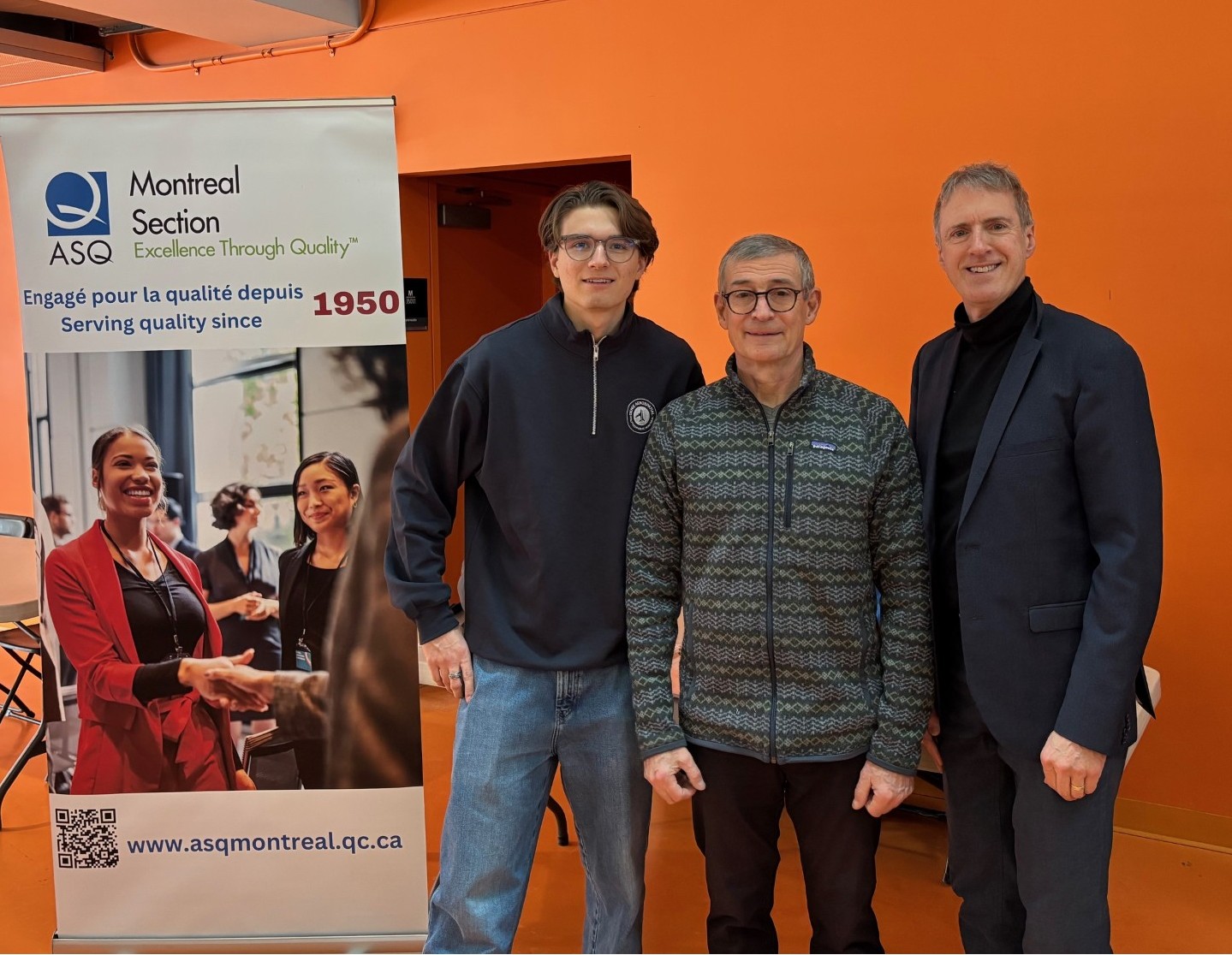
Sur invitation du CEGA (Comité Étudiant en Génie Aérospatiale), Eric HOSKING et Pierre MARQUIS ont représenté l’ASQ Montréal durant la journée carrière, affichant bannière et fiches des certifications offertes par l’ASQ. Cette journée était organisée par l’association des étudiants de Poly, concentrations génie mécanique et aérospatial. Sur la photo, le président du comité, Olivier GUY-SAMSON, avec nous.

Plusieurs étudiants(es) ont visité le kiosque pour obtenir de l’information sur les webinaires mensuels, les cours avec certification d’ASQ, les possibilités de mentorat et la revue Quality Progress. En plus du génie mécanique et aéro, des étudiants(es) en génie logiciel et informatique ce sont aussi présentés; parmi les cours d’ASQ investigués par les étudiants, on mentionne: “Certified Quality Engineer, Certified Reliability Engineer, Certified Software Quality Engineer et Certified Six Sigma Green Belt & Black Belt”.

Plusieurs entreprises manufacturières/service assuraient une présence, tel que Bombardier, Airbus, Air Canada Héroux-Devtek, L3 Harris, Famic (automatisation) et Techso (PLM). L’expérience fut un succès et nous a permis de nous afficher comme une organisation dynamique en qualité.

ACADEMIA:

  • Contactez-nous si vous souhaitez organiser un événement avec vos étudiants et discutons de la manière dont nous pouvons aborder le sujet de la qualité dans le monde universitaire.
  • Si vous faites partie d’un établissement d’enseignement et que vous souhaitez avoir plus de visibilité sur les sujets liés à la qualité, contactez Pierre Marquis sur LinkedIn. Nous disposons d’un réseau de conférenciers potentiels qui pourraient vous intéresser.

TWO RECENT STUDENT OUTREACH COMMITTEE EVENTS: UQAM and POLY MTL

1 – ASQ MTL STUDENT MENTORING PROJECT (December 9, 2025 – UQAM)

As part of the “Service Management and Design” course in the Master’s in Management program at UQAM, Professor Veronica Marquez, a senior member of ASQ and SSBB, supervised a student project aimed at providing a mentoring service to ASQ Montreal. Students Omar EL JAMALI, Mame CHEIK NIANG, and Serigne Fallou MBAKE SECK named their project E-Mentors, which they presented on December 9 to the class (colleagues and professor), in the presence of two leaders from the ASQ Montreal chapter, Raymond DYER and Pierre MARQUIS.

The goal of the E-Mentor project is to help rejuvenate the aging population of the ASQ by allowing young members to receive mentoring through pairing with senior members. The team followed a rigorous design process, the SERVQUAL model, which aims to help companies measure and control the quality of their services. The DCDV continuous improvement cycle also enabled the team to define the problem, characterize it, design a solution, and verify the service. Six metrics (KPIs) were proposed to measure the achievement of objectives, such as average time and completion rate of pairings and retention rate of junior members. The risks and limitations of the project were identified, such as funding, acceptance by the US headquarters, and heavy reliance on volunteers.

In conclusion, Raymond and Pierre thanked Omar, Mame, and Serigne for their interesting project. The ball is now in the court of ASQ Montreal’s leaders to decide whether or not to implement the project. Note that a project already exists for members in good standing, as the myASQ website has a “Mentor Match” feature that allows users to register as mentors or mentees. With this article, I invite all interested members to sign up; we need to test this system because there seem to be some bugs when searching.

2 – ASQ MTL at POLY MTL for the MECAERO CAREER DAY (January 27, 2026)

At the invitation of the CEGA (Aerospace Engineering Student Committee), Eric HOSKING and Pierre MARQUIS represented ASQ Montreal during the career day, displaying banners and information sheets about the certifications offered by ASQ. The event was organized by the Poly student association, mechanical and aerospace engineering concentrations. In the photo, the committee chair, Olivier GUY-SAMSON, is pictured with us.

Several students visited the booth to obtain information about monthly webinars, ASQ certification courses, mentoring opportunities, and Quality Progress magazine. In addition to mechanical and aerospace engineering students, software engineering and computer science students also attended. Among the ASQ courses investigated by students were: Certified Quality Engineer, Certified Reliability Engineer, Certified Software Quality Engineer, and Certified Six Sigma Green Belt & Black Belt.

Several manufacturing/service companies were present, including Bombardier, Airbus, Air Canada, Héroux-Devtek, L3 Harris, Famic (automation), and Techso (PLM). The experience was a success and allowed us to showcase ourselves as a dynamic organization in the field of quality.

ACADEMIA:

  • Contact us if you are organizing a student event and wish to discuss how to present quality-related topics in the university.
  • If you are part of an educational institution and would like to have more visibility on quality-related topics, please contact Pierre Marquis on LinkedIn. We have a network of potential speakers that may be of interest to you.


Student Outreach | Sensibilisation étudiante Read More »

Si vous étiez présent | Had You Been There

RÉSUMÉ DU WEBINAIRE “Using Appreciative Inquiry to Skyrocket Improvements”

By Pierre Marquis, Membership Chair Section Montréal, Student Outreach Committee Member (English text follows)

Organisé par Chantal SIMARD et Raymond DYER, sur la plateforme Zoom. Présentateur: Michael HART, PDG et fondateur de HUMAN.

Introduction:

Le 28 janvier dès 18h30, 22 participants ont pris le temps d’assister à un webinaire de 2,5 heures, afin d’en apprendre sur l’utilisation d’enquête appréciative pour accélérer les améliorations.

De 18h30 à 19h les participants ont pu réseauter en mode virtuel sous la direction de M. Raymond DYER et de Mme Chantale SIMARD, et rencontrer une partie de l’équipe de leadership d’ASQ Montréal, sous la forme d’un tour de table virtuel. Les 19 certifications d’ASQ, la mission et le code d’éthique d’ASQ ont été mentionnés. Un sondage d’ouverture a révélé que la majorité des participants sont membres séniors d’ASQ, de la région de Montréal et travaillent en qualité manufacturière; certains venaient des USA (San Diego, Seattle), d’Ottawa, Alberta, Québec, etc., ce qui est intéressant. Raymond a présenté l’agenda de la soirée et introduit le conférencier, M. Michael HART.

Déroulement, dès 19h:

Le présentateur a débuté en nous présentant deux participants ayant assisté à une récente session en présentiel à Ottawa sur le même sujet, soit Lisa et Jim, qui ont témoigné de leur expérience enrichissante à la fin du webinaire.

L’enquête appréciative (EA) est une approche de changement organisationnel et social fondée sur les forces qui met l’accent sur ce qui fonctionne bien plutôt que sur ce qui doit être corrigé. Le processus se compose de 5 étapes: La définition et 4 phases pour définir et implanter le changement transformationnel: Définir par un sujet affirmatif au lieu d’un problème. Phases: Découvrir, rêver, concevoir et livrer; la méthode a été développée par David COOPERRIDER, de l’université “Case Western Reserve” de Cleveland, Ohio.

Des entreprises mondiales l’ont utilisé pour provoquer un changement transformationnel: Verizon, NASA, Les Nations Unies, British Airways, Dépt de la justice (gouv. canadien), etc. L’animateur l’a utilisé avec succès lors d’un mandat de réingénierie de processus avec le gouvernement de Trinidad et Tobago, qui visait à se réinventer. Le résultat fut d’aider les gens à donner le meilleur d’eux-mêmes, en appliquant le processus d’EA à la gestion de la performance individuelle.

Ensuite les participants ont été conviés à une session d’entrevue en équipe de deux, en salle de pause, afin d’essayer la phase de découverte; nous devions nous remémorer une expérience de travail particulièrement gratifiante et la partager. L’animateur a poursuivi avec la phase rêve, ou comment créer des organisations prêtes pour le futur? La science qui soutient l’EA se compare à l’effet Hawthorne, soit le phénomène qui fait que les gens modifient leur comportement lorsqu’observés, pouvant résulter en gains de productivité. Pour en apprendre d’avantage, M. Hart a fourni un lien (anglais seulement): Conscious-Human-Intention-in-the-Workplace-condensed-version.pdf

Conclusion:

L’audience du webinaire a été très satisfaite de la qualité de la présentation et du degré d’interaction entre les participants. Les résultats du sondage témoignent de la satisfaction des répondants, avec un résultat global de satisfaction de 4.75/5.

Pour terminer, Raymond a annoncé la date du prochain webinaire, soit le 25 février, ayant comme thème la résolution de problème. Chantale et Raymond ont sincèrement remercié Michael pour sa prestation et les participants pour leur présence active.


WEBINAR SUMMARY “Using Appreciative Inquiry to Skyrocket Improvements”

Introduction:

On January 28 at 6:30 p.m., 22 participants took the time to attend a 2.5-hour webinar to learn about using appreciative inquiry to skyrocket improvements.

From 6:30 p.m. to 7 p.m., participants were able to network virtually under the guidance of Mr. Raymond DYER and Ms. Chantale SIMARD, and meet part of the ASQ Montreal leadership team in a virtual roundtable discussion. The 19 ASQ certifications, ASQ’s mission, and ASQ’s code of ethics were mentioned. An opening survey revealed that most participants are senior ASQ members from the Montreal area who work in manufacturing quality; some came from the US (San Diego, Seattle), Ottawa, Alberta, Quebec City, etc., which is interesting. Raymond presented the evening’s agenda and introduced the speaker, Mr. Michael HART.

Schedule, starting at 7 p.m.:

The presenter began by introducing two participants who had attended a recent in-person session in Ottawa on the same topic, Lisa and Jim, who shared their enriching experience at the end of the webinar.

Appreciative Inquiry (AI) is a strengths-based approach to organizational and social change that focuses on what works well rather than what needs to be corrected. The process consists of five steps: Definition and four phases to define and implement transformational change: Define using an affirmative topic rather than a problem. Phases: Discover, dream, design, and deliver. The method was developed by David Cooperrider of Case Western Reserve University in Cleveland, Ohio.

Global companies have used it to bring about transformational change: Verizon, NASA, the United Nations, British Airways, the Canadian Department of Justice, etc. The facilitator used it successfully during a process re-engineering mandate with the government of Trinidad and Tobago, which was seeking to reinvent itself. The result was to help people give their best, by applying the AI process to individual performance management.

Participants were then invited to a team interview session in pairs in the break room to try out the discovery phase; we had to recall a particularly rewarding work experience and share it. The facilitator continued with the dream phase, or how to create organizations that are ready for the future. The science behind AI is comparable to the Hawthorne effect, the phenomenon whereby people change their behavior when observed, which can result in productivity gains. To learn more on AI, Mr. Hart provided a link: Conscious-Human-Intention-in-the-Workplace-condensed-version.pdf

Conclusion:

The webinar audience was very satisfied with the quality of the presentation and the level of interaction between participants. The survey results reflect the respondents’ satisfaction, with an overall satisfaction rating of 4.75/5.

Finally, Raymond announced the date of the next webinar, February 25, with problem solving as the theme. Chantale and Raymond sincerely thanked Michael for his presentation and the participants for their active participation.

Si vous étiez présent | Had You Been There Read More »

Mot de la présidente | Word from the Chair

Par Chantale Simard, MBA, ASQ Senior Member, CSSGB (English text follows)

Une équipe de leadership en pleine croissance

Le comité de direction de l’ASQ Montréal poursuit sa croissance et se renforce grâce à l’arrivée de nouveaux leaders et à l’implication active de bénévoles engagés.

Nous sommes heureux d’annoncer l’arrivée de cinq nouveaux membres au sein du comité de direction :

  • Mutair Kadiri, responsable de la recertification

  • Abdellatif Fqihi, responsable des médias sociaux

  • Hani Antar, membre des comités programme et éducation

  • Claudio Sasseron, responsable du comité Voice of the Customer (VOC)

  • Louis-Césaire Ngonzo-Biyo, nouvellement joint au comité de direction

Ces nouveaux membres assument déjà plusieurs rôles clés et contribuent activement à l’évolution de la section.

Nouvellement joint à l’équipe de leadership, Louis-Césaire Ngonzo-Biyo a déjà proposé des pistes concrètes pour faire évoluer le comité Web et médias sociaux vers une approche plus structurée en matière de communications et d’image de marque, tout en demeurant pleinement alignée avec les cadres, politiques et valeurs de l’ASQ.

Nous souhaitons également souligner l’implication remarquable de Kunal Das, bénévole et membre étudiant, qui participe à nos réunions à titre d’invité et soutient activement le comité de sensibilisation étudiante (Student Outreach Committee). Ses idées, notamment en lien avec la diffusion de nos événements sur des plateformes complémentaires à celles que nous utilisons actuellement — l’infolettre, Eventbrite, LinkedIn, le site Web de l’ASQ Montréal et MyASQ — enrichissent concrètement nos réflexions. Nous espérons pouvoir l’accueillir officiellement au sein du comité de direction lorsqu’il deviendra membre régulier.

Cette énergie collective, portée par la diversité des expertises et l’engagement de chacun, contribue directement au rayonnement et à l’avenir de l’ASQ Montréal.

Envoyez-moi vos commentaires


A Leadership Team Gaining Momentum

The ASQ Montreal Section Leadership Team continues to grow and strengthen through the addition of new leaders and the active involvement of dedicated volunteers.

We are pleased to announce the addition of five new members to the Leadership Team:

  • Mutair Kadiri, Recertification Chair

  • Abdellatif Fqihi, Social Media Chair

  • Hani Antar, Program and Education Committees Member

  • Claudio Sasseron, Voice of the Customer (VOC) Chair

  • Louis-Césaire Ngonzo-Biyo, newly joined member of the Leadership Team

These new leaders are already taking on multiple key roles and actively contributing to the section’s growth.

As a newly joined member of the Leadership Team, Louis-Césaire Ngonzo-Biyo has already put forward ideas to evolve the Web and Social Media Committee toward a more structured approach to communications and branding, while remaining fully aligned with ASQ frameworks, policies, and values.

We would also like to recognize the outstanding involvement of Kunal Das, a volunteer student member who participates in our meetings as a guest and actively supports the Student Outreach Committee. His ideas, particularly around expanding the promotion of our events on additional platforms beyond those currently used — our newsletter, Eventbrite, LinkedIn, the ASQ Montreal website, and MyASQ — are already contributing meaningful value. We look forward to welcoming him as an official member of the Leadership Team once he becomes a regular member.

This collective energy and diversity of expertise are shaping a strong and vibrant future for the ASQ Montreal Section.

Send me your comments


Suivez-nous sur LinkedIn

Explorez NOTRE site myASQ Montréal |  Explore OUR Montreal myASQ site.

Mot de la présidente | Word from the Chair Read More »

Voice of The Customer | Voix du Client

By Claudio Sasseron, Responsable VoC, (English text follows)

Il est très gratifiant de travailler en écoutant attentivement les retours des membres et des participants aux rencontres et présentations. Au cours des derniers mois, j’ai eu l’occasion d’assister à plusieurs présentations de grande qualité, couvrant des sujets variés dans différentes industries, et mettant en avant les meilleures pratiques du marché ainsi que des perspectives enrichissantes, tant sur le plan professionnel que personnel. Les échanges avec des professionnels aussi expérimentés rendent cette expérience particulièrement stimulante.

Je suis convaincu que cette année sera marquée par de belles rencontres, un apprentissage continu et un fort développement collectif. Un bon exemple est le premier webinaire de l’année, qui a proposé une excellente présentation sur l’Appreciative Inquiry. L’approche présentée offrait une vision transformationnelle de l’amélioration des services et des produits, allant au-delà de l’analyse des défauts et des réclamations, et a atteint un taux de 94% de satisfaction globale.

Parmi les thèmes les plus suggérés pour les prochains événements figurent l’intelligence artificielle, les normes ISO, notamment ISO 9001 et AS9100, ainsi que le développement d’une culture de la qualité.

À la prochaine!

Claudio Sasseron


It is truly rewarding to work by actively listening to feedback from members and participants during meetings and presentations. Over the past few months, I have attended several high-quality presentations covering a wide range of topics across different industries, showcasing best market practices and providing valuable insights for both professional growth and personal development. Engaging with such experienced professionals makes this experience even more meaningful.

I am confident that this year will bring many valuable connections, continuous learning, and strong collective development. A great example was the first webinar of the year, which featured an excellent presentation on Appreciative Inquiry. The approach introduced a transformational perspective on service and product improvement, moving beyond a traditional focus on defects and complaints, and achieved an overall 94% satisfaction rate.

Among the most requested topics for upcoming events are artificial intelligence, ISO standards, particularly ISO 9001 and AS9100, and the strengthening of a strong quality culture.

See you soon!

Claudio Sasseron

Voice of The Customer | Voix du Client Read More »

Scroll to Top